
Thursday, February 6, 2014
Why Should You Write?

Thursday, January 30, 2014
The Twinkling of an Eye
I haven't read any great literature lately. But, I have been reading. And studying. And singing. And so, in that order, let me catch you up.
 One of the books I finished last week is not a book I can just out and out recommend that everyone should read. When I saw it at a used bookstore in Leesburg (a wonderful little bookshop you should visit, Books and Other Found Things), I thought it might not be a bad idea for me to look at the whole midwifery thing from a more human point of view. Studying it in textbooks is one thing; viewing it through the eyes of actual people (fictional though they might be) is something else. I'm not even convinced that I like it. I think that, as a novel, it was somewhat lacking, particularly in it's shoddy conclusion.
The story: Sybil Danforth lives with her husband and 14 year old daughter in a small town in northern Vermont. She has an established midwifery practice and a good reputation in the world of maternity and natal care. But one night, circumstances combine in the worst way possible, and she ends up performing an emergency C-section with a kitchen knife. Grisly business. As you might imagine, all hell breaks loose and she ends up going to trial for involuntary manslaughter.
It is, in many ways, a compelling story. For particular people, it's a good story to read. Expectant mothers should not read it. Women thinking of becoming midwives should, though. It's a real eye-opener, and will make you stop and think seriously about the messier side of the profession. Gents, I don't know if any of you would be interested in such a thing. If you're curious about the world of midwifery, it would certainly be informative; the book is well researched. But beware the frequency (and sometimes gratuitous use) of gynecological vocabulary. It comes with the territory.
As far as school is concerned, this will be a much easier semester than last one was. I have fewer classes, and two of them are about words and writing (Medical Terminology and Writing for Midwives), which means that they come easily enough and I get to nerd out over etymologies. So far, the word to end all words: endoscopicretrogradecholangiopancreatography. Boo-yah. My third class is Holistic Health, for which I do things like making tonics and yogurt and playing with herbs and oils. I feel... crunchy. I do actually have a book recommendation for you on this one, though. I always appreciate it when cookbook authors understand language and food together. The author of Nourishing Traditions, Sally Fallon, is such a culinary scribe. For example, here she is expounding upon the problems that arise if we forget about real nutrition when we utilize technology in food production (fascinating, I know):
And this is how we sound when we sing. You'll have to forgive the poor quality of the recording; likely it's from a phone set out on the railing in front of us. (By the way, I just uploaded this to YouTube today. Share it with your friends! Help us get some more views!)
One of the books I finished last week is not a book I can just out and out recommend that everyone should read. When I saw it at a used bookstore in Leesburg (a wonderful little bookshop you should visit, Books and Other Found Things), I thought it might not be a bad idea for me to look at the whole midwifery thing from a more human point of view. Studying it in textbooks is one thing; viewing it through the eyes of actual people (fictional though they might be) is something else. I'm not even convinced that I like it. I think that, as a novel, it was somewhat lacking, particularly in it's shoddy conclusion.The story: Sybil Danforth lives with her husband and 14 year old daughter in a small town in northern Vermont. She has an established midwifery practice and a good reputation in the world of maternity and natal care. But one night, circumstances combine in the worst way possible, and she ends up performing an emergency C-section with a kitchen knife. Grisly business. As you might imagine, all hell breaks loose and she ends up going to trial for involuntary manslaughter.
It is, in many ways, a compelling story. For particular people, it's a good story to read. Expectant mothers should not read it. Women thinking of becoming midwives should, though. It's a real eye-opener, and will make you stop and think seriously about the messier side of the profession. Gents, I don't know if any of you would be interested in such a thing. If you're curious about the world of midwifery, it would certainly be informative; the book is well researched. But beware the frequency (and sometimes gratuitous use) of gynecological vocabulary. It comes with the territory.
As far as school is concerned, this will be a much easier semester than last one was. I have fewer classes, and two of them are about words and writing (Medical Terminology and Writing for Midwives), which means that they come easily enough and I get to nerd out over etymologies. So far, the word to end all words: endoscopicretrogradecholangiopancreatography. Boo-yah. My third class is Holistic Health, for which I do things like making tonics and yogurt and playing with herbs and oils. I feel... crunchy. I do actually have a book recommendation for you on this one, though. I always appreciate it when cookbook authors understand language and food together. The author of Nourishing Traditions, Sally Fallon, is such a culinary scribe. For example, here she is expounding upon the problems that arise if we forget about real nutrition when we utilize technology in food production (fascinating, I know):
The wise and loving marriage of modern invention with the sustaining nurturing food folkways of our ancestors is the partnership that will transform the Twenty-First Century into the Golden Age; divorce hastens the physical degeneration of the human race, cheats mankind of his limitless potential, destroys his will and condemns him to the role of undercitizen in a totalitarian world order.
It's okay. I know. Just breathe. I never thought of food in such a teleological manner either. But perhaps we can start together, and gradually help each other to think more apocalyptically about our PB&J. By the way, Sally Fallon understands butter and whole milk. Fat is good for you, people. Eat it. Drink it. In moderation.
Singing. Oh the drama. The choir I've been singing with at weddings, masses and holy hours for the last year and a half just put on our first honest-to-goodness concert. Usually we get to hide in a choir loft. But on Tuesday night I was approximately a foot and a half away from the ears of the guy in the front row. No pressure, you know? But, we made it through! And it seems it all went off well enough, despite the fact that we sang a few modern pieces; they're not really our forte. (Ha! Get it?) So now I'm going to do a bit of promoting. You should go check us out on Facebook and look over our upcoming events: https://www.facebook.com/thechorussinenomine.
 |
| It's hard to get everyone to open their eyes at the same time. Especially when they're sleepy. |
And this is how we sound when we sing. You'll have to forgive the poor quality of the recording; likely it's from a phone set out on the railing in front of us. (By the way, I just uploaded this to YouTube today. Share it with your friends! Help us get some more views!)
Okay. I think that's just about enough for today. One last bit: The title of today's post is from 1 Cor 15:51-58. It's all about abounding in good work and looking forward to that moment at the end of all time when we'll be transformed, imperishable, and death will be swallowed up in victory. It's been running through my head for the last week. You should go read it; it's like a work-out song, but in a noble way, like the beginning of Chariots of Fire. It'll make you feel tall and strong and indubitably indomitable. Enjoy!
Thursday, January 9, 2014
Where Do We Go Now?
I've been given leave to share some year-old correspondence with you all; although the thoughts aren't hot off the press, they are, nonetheless, not yet out-dated. Enjoy!
In query to me:
In query to me:
So, here's a big question: do you ever speculate on the future of English poetry as such? Like, where the whole enchilada is going from here? From my impoverished standpoint, it seems as if the last really original poet in the language was Eliot, almost a hundred years ago now. I mean, I guess Ginsberg did something sort of new, in the sense of taking the dissolution of thought about as far as one can while still being at least nominally coherent, but that's a false path if there ever was one. It feels like the rest of us are just sort of chewing over the old forms and watching them get staler and staler. There's never going to be another great epic; the sonnet is beginning to feel antiquated even to me, who love sonnets more than pizza (well, some days, anyway); and free verse seems to have largely devolved into simply an excuse not to bother with finding viable rhymes while talking about one's feelings or opinions. So where exactly do we, or can we, go from here? The language itself may have to start changing pretty radically in order to open new doors of expression--but then again, it's poetry itself that drives changes in language, or ought to be. (Ever read Poetic Diction, by Owen Barfield? It's one of those books that end up shaping the foundations of my every waking thought. The gist, in extreme brief, is that Poetry and Thought Itself are eternally connected in a sort of reciprocal chicken-and-egg cycle of influence. Profound stuff.) I dunno, dude. I kick this around in my head from time to time, and lately it's been head-kicking time around here once again. I'm not sure I'm any closer to a useful idea, tho'. Any thoughts?And my response:
I don’t know. I do wonder about it – not, I think, as often as you do, or with such apparent intensity. I entirely agree with your interpretation of modern free verse; it is romanticism at its lowest, most unintellectual and solipsistic form. I’m a huge fan of writing in regular rhythm and meter. I feel a little like a character in one of Edward Eager’s books who, upon hearing that most modern poets don’t rhyme, sniffs and says, “Hmph! Lazy things!”
I suppose one option for forward progression is to return to skillful use of form with modern language. Yes, the sonnet, for example, is antiquated, and so it does in a way make sense to use archaic language when writing one, but perhaps we need to start working within the strictures of iambic pentameter, or any regular type of meter and foot, using colloquial diction. A return to form of any sort, at this point in our free-love free-everything radically liberal world that rejects structure in the name of individuality and rights, would be a vast improvement and a gigantic leap. Maybe we can get villanelles to replace sonnets as THE POETIC FORM. I’ve never read one that I’ve been really convinced by; the repetition always seems contrived and sort of sing-songy. Get on that.
I don’t know Ginsberg. Can you tell me more about that?
Unfortunately, I don’t see our language changing radically anytime soon. As everything in our world becomes smaller and more universal, idiosyncrasies of dialects and regional linguistic movements have less and less chance of survival and development. I heard a radio show the other day about how many distinct accents there used to be in Texas, and how so many of them have either already died out or are on their way out. Last time I was in Europe, people were surprised that I was American, as I didn’t have a particular regional accent. Many assumed I was British. (Yes, even in Scotland. Go figure.) Of course, they could have been limited in their view of how Americans speak. But seeing as I have lived, among other places, almost 8 years in Dallas and 12 near Boston, both of which places have fairly distinctive accents, you’d think that I’d speak one way or the other. Once in a great while I hear myself drop an r from the end of a word, and I do say both ya’ll and wicked from time to time. (“Ya’ll come ovah hee-ah wicked fast.”) But with these particularities of speech habits fading out, the more substantial structure of the language will continue, I believe, to become increasingly universalized and less exciting. Unless there is a huge disturbance to the world order, a dissolution of equalizing technology and world-wide communication, not to mention an eradication of blandi-fying TV, I don’t know that the language will do anything but become more standardized. That clip of The Three Little Pigs Shakespeare-style is, I think, a clear enough example of how much our language has declined in richness over the centuries. If only we had some barbarians with a currently unknown language who could rise up from somewhere, conquer the English speaking world, mix their language with ours, and somewhere 100 years down the road allow for an incredible wealth of novel and rich poetry, we might have some hope. Besides the linguistic wealth and innovation such an occasion would allow, we would have some pretty fantastic subject matter. I mean, hell, we might get another Aeneid out of that! And maybe our neo-Virgil would actually finish the story this time around.
All of that being said, I did go to a lecture last night on Sunni Jihadist Islamic militant movements in North Africa and the Middle East. The speaker seems to think that we’ve got 5-10 years before the failed tactical methods of the U.S. in the area will come back to bite us and all hell will break loose as a radically violent religious ideological organization that spans portions of two continents and 10-15 countries makes war on the remnants of Western Civilization. So that was a little scary. Silver lining? If that happens, we might get some good poetry out of it. Hmm. Perhaps you and I need to realign our priorities.
Poetic Diction by Owen Barfield. I have not read it. His thesis is one to which I’ve given a fair amount of thought, however, and it sounds like I agree with him. I think that good writing is a reflection and refinement of the thoughts of the times, stemming from them, but saying them more cohesively than they have been expressed, thereby allowing the people to know what they’re thinking with a clarity previously unheld. Certainly, the refinement of the thoughts shapes them in a particular direction, which is where the chicken-egg overlap happens. So yeah, I think I would like Mr. Barfield. I like his name, too, for that matter.
Anyway, thanks! It’s always good to have a chance to think about this stuff. And did I mention how much I enjoy writing? It’s just great. The Toilet Limerick, by the way, is something that I thought that you particularly would enjoy. Was I right? Oh, and about that, does a proper limerick have to be in anapestic trimeter in lines 1, 2 and 5? I started beating out the several limericks I know, and discovered many variations in syllable length for each of those lines. Most were somewhere from 8 to 10 syllables, but even that is quite a margin. I think I decided that since it is such a trivial verse form, attention to detail needn’t be so strictly observed. But then, maybe that’s me being the lowest form of Romantic poet. Ah well.Well, friends, I hope we've given you some food for thought. Get to it! I would like 5 villanelles by the close of business, please.
Friday, January 3, 2014
When the Goad Rises
What do you hate when you're hating, and why do you hate it? Or, How to stop being such a pompous ass.

Posted over on Dappled Things today. Merry Christmas, Cheers and a Happy New Year, peeps!

Posted over on Dappled Things today. Merry Christmas, Cheers and a Happy New Year, peeps!
Tuesday, December 17, 2013
The Gift of the Magi
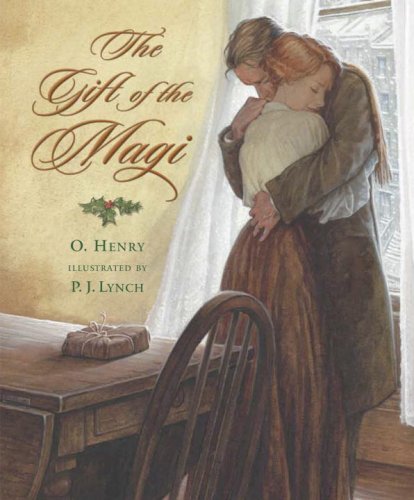 Do you all know P.J. Lynch? He's done illustrations for lots of children's books, such as The Christmas Miracle of Jonathan Toomey, and he's also apparently collaborated on a book of Irish myths and legends, something I could totally go for. I was doing some Christmas shopping at Barnes and Noble a few nights ago (shocker), and I came across O. Henry's story, The Gift of the Magi, done with P.J. Lynch's illustrations. If you're not sure what to get for that niece or nephew, or really anyone (I am a firm believer in giving kids' books to adults), do yourself and them a favor and go get this one. The combination of O. Henry's little side conversations he has with his readers, his excellent word choices and his fondness for his characters, coupled with the warm and gently beautiful illustrations, makes for a delightful read. Some of my favorite bits and pieces (the first one, admittedly, because it thematically ties in so nicely with my previous post):
There was clearly nothing to do but flop down on the shabby little couch and howl. So Della did it. Which instigates the moral reflection that life is made up of sobs, sniffles, and smiles, with sniffles predominating. (That's for you, Mary Powers.)
Now, there were two possessions of the James Dillingham Youngs in which they both took a mighty pride. One was Jim's gold watch that had been his father's and his grandfather's. The other was Della's hair. Had the Queen of Sheba lived in the flat across the airshaft, Della would have let her hair hang out the window some day to dry just to depreciate Her Majesty's jewels and gifts. Had Kind Solomon been the janitor, with all his treasures piled up in the basement, Jim would have pulled out his watch every time he passed, just to see him pluck at his beard from envy.
Oh, and the next two hours tripped by on rosy wings. Forget the hashed metaphor. She was ransacking the stores for Jim's present.
She got out her curling irons and lighted the gas and went to work repairing the ravages made by generosity added to love. Which is always a tremendous task, dear friends -- a mammoth task.

"Maybe the hairs of my head were numbered, but nobody could ever count my love for you." Out of his trance Jim seemed quickly to wake. He enfolded his Della. For ten seconds let us regard with discreet scrutiny some inconsequential object in the other direction.
So, yes. Go buy the book. Or buy five copies of it. And get The Christmas Miracle of Jonathan Toomey while you're at it. Merry Christmas, friends!

Saturday, December 7, 2013
Why Comedies Make Us Sad
I remember a friend saying once that he never feels happy at Easter or Christmas, and that he gets inappropriately joyful during Lent. And I know what he meant! I realize how petulant this might sound, but I can't remember the last time I didn't feel let down at Christmas. "Is this all? Surely there must be something else." Yes, childish a thought it might well be, but I will venture to protect my dignity by saying I'm actually hitting on something deep in that dissatisfaction. And while I do experience some joy on Easter, and there have occasionally been giddy-happy Easters (really only one comes to mind), I usually feel much more at home on Good Friday and often do get that sense of a big, giant let-down come Easter Sunday.
Gillian Welch is one of my all time favorite musicians. She has a dark sort of heavy low voice and sings a lot of depressing bluegrass songs, which is why people usually turn up their noses when I say, "Oh my gosh! You don't know Gillian Welch? You have to listen to this." They listen to 30 seconds of her with a wrinkled nose and a frown, at which point I stop casting my pearls. One of her songs (not actually one of my favorites, but this one is, if you'd like to try not being a swine) has a verse in it that pretty much sums up my whole attitude about tragedies:
Now even if you don't like her voice, can we at least agree she's dead on here? There is nothing more obnoxious when you're in the pits than cheerful people. If we're feeling sad and out of it, sometimes the appropriate thing to do is wallow. Yes, under certain conditions, I approve of wallowing. And the best way to wallow is to find other wallowers. Go have "a good cry," with a marked emphasis on good.
I'm going to go a step further, and this is where you all might take issue with my position (as so many of my friends have already in conversation). Even when I'm on top of the moon, I get that little voice niggling in the back of my head saying such helpful things as, "Enjoy it while it lasts, Ellen, cause you know what's just around the corner. Everything will be back to its usual self before long." This, in short, is why comedies never really do it for me. And I'm talking about comedy in that sometimes-forgotten sense that the Greeks and other playwrights meant it; it doesn't have to be something silly -- it just has to end with order instead of chaos. I'm not saying I never cheer when the hero gets his lady-love, or that I sulk in the corner when Maleficent is thwarted and defeated (Sleeping Beauty is superb, by the way; the hero conquers "All the powers of hell" with the "Sword of Truth" allowing that "evil die and good endure.") But there is, nonetheless, that something niggling that also says, "Yes, that's all as it should be, and, you're not there yet." Comedies make us feel lonesome and dissatisfied, somewhere underneath, because they aren't true to the life we know here on earth. They highlight, they emphasize, that sense of isolation and not really belonging and wondering where on earth our place is.
And hey, that's where the problem lies. Our place isn't on earth. Of course we never feel entirely right or comfortable here. Comedies can help us by giving us a paradigm of how we should try to live, and what, in the grand scheme of things, will happen (Jesus won, by the way), but the fact of the matter is we're still in the trenches. While the universe has been claimed for The Good, we, as individuals, haven't reached that end yet. The conclusion of a proper comedy shows an ordered state where we aren't and haven't yet been. But we know in our heart of hearts we belong there. It would be decidedly odd if we could look in through that window and not get some sense of longing or yearning.
And I suppose that this is why liturgically penitential seasons make more sense to our sorry selves than the joyful ones. Perhaps our inability to experience that palpable joy is in direct proportion to our selfishness, as in, we can't bring ourselves to get over ourselves and get happy about the big picture victory. Maybe that's my problem. Because yes, Jesus has fought that fight and conquered Death for all mankind. He did it for me, too. But if my particular share in the battle were already won, I wouldn't have this daily struggle nonsense to deal with. Sometimes, the majority of the time, there's a trouble in my soul, and it's good and helpful and human for me to hear a worried song, sung by someone else who's also been down in a hole. Death shalt die. Thank you, Mr. Donne, for the future tense. We know it will happen, eventually, and we can take certain comfort in that, but we're not there yet.
And with that, here's another Gillian Welch song, quite possibly my very favorite one. The relevant words here are in the chorus (but it's all a good song):
Gillian Welch is one of my all time favorite musicians. She has a dark sort of heavy low voice and sings a lot of depressing bluegrass songs, which is why people usually turn up their noses when I say, "Oh my gosh! You don't know Gillian Welch? You have to listen to this." They listen to 30 seconds of her with a wrinkled nose and a frown, at which point I stop casting my pearls. One of her songs (not actually one of my favorites, but this one is, if you'd like to try not being a swine) has a verse in it that pretty much sums up my whole attitude about tragedies:
Now there's something good in a worried song
For the trouble in your soul.
For a worried man's been a long time down,
Down in a deep dark hole.
Now even if you don't like her voice, can we at least agree she's dead on here? There is nothing more obnoxious when you're in the pits than cheerful people. If we're feeling sad and out of it, sometimes the appropriate thing to do is wallow. Yes, under certain conditions, I approve of wallowing. And the best way to wallow is to find other wallowers. Go have "a good cry," with a marked emphasis on good.
 |
| Migrant Mother, by Dorothea Lange (framed with Gillian Welch in my house; I always think of them together) |
I'm going to go a step further, and this is where you all might take issue with my position (as so many of my friends have already in conversation). Even when I'm on top of the moon, I get that little voice niggling in the back of my head saying such helpful things as, "Enjoy it while it lasts, Ellen, cause you know what's just around the corner. Everything will be back to its usual self before long." This, in short, is why comedies never really do it for me. And I'm talking about comedy in that sometimes-forgotten sense that the Greeks and other playwrights meant it; it doesn't have to be something silly -- it just has to end with order instead of chaos. I'm not saying I never cheer when the hero gets his lady-love, or that I sulk in the corner when Maleficent is thwarted and defeated (Sleeping Beauty is superb, by the way; the hero conquers "All the powers of hell" with the "Sword of Truth" allowing that "evil die and good endure.") But there is, nonetheless, that something niggling that also says, "Yes, that's all as it should be, and, you're not there yet." Comedies make us feel lonesome and dissatisfied, somewhere underneath, because they aren't true to the life we know here on earth. They highlight, they emphasize, that sense of isolation and not really belonging and wondering where on earth our place is.
And hey, that's where the problem lies. Our place isn't on earth. Of course we never feel entirely right or comfortable here. Comedies can help us by giving us a paradigm of how we should try to live, and what, in the grand scheme of things, will happen (Jesus won, by the way), but the fact of the matter is we're still in the trenches. While the universe has been claimed for The Good, we, as individuals, haven't reached that end yet. The conclusion of a proper comedy shows an ordered state where we aren't and haven't yet been. But we know in our heart of hearts we belong there. It would be decidedly odd if we could look in through that window and not get some sense of longing or yearning.
And I suppose that this is why liturgically penitential seasons make more sense to our sorry selves than the joyful ones. Perhaps our inability to experience that palpable joy is in direct proportion to our selfishness, as in, we can't bring ourselves to get over ourselves and get happy about the big picture victory. Maybe that's my problem. Because yes, Jesus has fought that fight and conquered Death for all mankind. He did it for me, too. But if my particular share in the battle were already won, I wouldn't have this daily struggle nonsense to deal with. Sometimes, the majority of the time, there's a trouble in my soul, and it's good and helpful and human for me to hear a worried song, sung by someone else who's also been down in a hole. Death shalt die. Thank you, Mr. Donne, for the future tense. We know it will happen, eventually, and we can take certain comfort in that, but we're not there yet.
And with that, here's another Gillian Welch song, quite possibly my very favorite one. The relevant words here are in the chorus (but it's all a good song):
We cannot have all things to please us
No matter how we try
Until we've all gone to Jesus
We can only wonder why.
House-keeping:
- I've been redrafting some of the more popular posts from here for my writing duties over at Dappled Things blog (Deep Down Things) on the 3rd and 21st of every month. So, if you want a chance to revisit some old discussions, and see what other people are writing about, amble over.
- I've got about a week left in the semester. Please say a prayer or two that I finish all my work in time!
- I'm more sorry than you know that the frequency and sometimes the thoughtfulness of my posts here have declined. Unfortunately, things being what they are, I'm afraid that won't change any time soon. I have many things I would like to write about for you all (I carry a list around with me these days entitled "Blog Ideas to Develop") but I have that whole "Be responsible; do your work" voice niggling along with all the others. Lots of voices in this head . . .
Monday, November 25, 2013
Dappled Things and Other Things
I don't think I've yet mentioned here that I started work as an assistant editor for Dappled Things in early September. Most of you might know that magazine already. If you don't, check out their website. Oh yeah, and their blog, because, you see, I get to help with that, too!
I get to do lots of stuff for them like sorting submissions, recommending which pieces deserve further consideration, discussing and voting on final acceptance, and then editing the work when it's been accepted and getting in touch with authors about making any necessary changes. I've really enjoyed the work, even on top of my regular job and school and choir, because it makes me think seriously about the kind of writing I like to think about, and it gets me in touch with some really fantastic people. Also, it turns out that two of the guys I knew in college, Chris Petter and David Harman, do work for them as well. As a result, I get to feel very smug about my alma mater; who doesn't love that?!


All the behind-the-scenes work for the magazine is done online, which is how it can be staffed with people from all over the place -- and I'm talking from different countries, not just Montana or Virginia. Another awesome thing about it is that it's a hardcore non-profit, meaning we all do the work because we love it and believe in it; no paychecks involved. Don't get me wrong. I would be ever so happy to get an extra paycheck every once in a while. But, it also makes me happy to do this work, paycheck or no.
Our founder, Bernardo Aparicio Garcia, recently sent out a short fundraising video and asked the staff if we could spread it around (printing and distribution costs add up, you know). He talks about the mission of the magazine, the role of beauty in our culture, and what we can do in the world of art to rededicate modernity to its proper end. So give it a look-see, wander over to the fundraising page, and think about what you might do.
I'll leave you today with some words from Gerard Manley Hopkins, as it is his poem, Pied Beauty, that was the inspiration for the name of this magazine. I've been thinking a lot this last month about the relationship between joy and sorrow, and our attraction to sad things, and why we sometimes experience desolation when reason tells us we should be joyful. Hopefully, that will come out as a full-length blog post before too long. In the meantime:
I get to do lots of stuff for them like sorting submissions, recommending which pieces deserve further consideration, discussing and voting on final acceptance, and then editing the work when it's been accepted and getting in touch with authors about making any necessary changes. I've really enjoyed the work, even on top of my regular job and school and choir, because it makes me think seriously about the kind of writing I like to think about, and it gets me in touch with some really fantastic people. Also, it turns out that two of the guys I knew in college, Chris Petter and David Harman, do work for them as well. As a result, I get to feel very smug about my alma mater; who doesn't love that?!


All the behind-the-scenes work for the magazine is done online, which is how it can be staffed with people from all over the place -- and I'm talking from different countries, not just Montana or Virginia. Another awesome thing about it is that it's a hardcore non-profit, meaning we all do the work because we love it and believe in it; no paychecks involved. Don't get me wrong. I would be ever so happy to get an extra paycheck every once in a while. But, it also makes me happy to do this work, paycheck or no.
Our founder, Bernardo Aparicio Garcia, recently sent out a short fundraising video and asked the staff if we could spread it around (printing and distribution costs add up, you know). He talks about the mission of the magazine, the role of beauty in our culture, and what we can do in the world of art to rededicate modernity to its proper end. So give it a look-see, wander over to the fundraising page, and think about what you might do.
I'll leave you today with some words from Gerard Manley Hopkins, as it is his poem, Pied Beauty, that was the inspiration for the name of this magazine. I've been thinking a lot this last month about the relationship between joy and sorrow, and our attraction to sad things, and why we sometimes experience desolation when reason tells us we should be joyful. Hopefully, that will come out as a full-length blog post before too long. In the meantime:
What would the world be, once bereft
Of wet and wildness? Let them be left,
Oh let them be left, wildness and wet;
Long live the weeds and the wilderness yet.
-Inversnaid
 |
| Yours truly hiking near Inversnaid, June 2011 |
Subscribe to:
Posts (Atom)