Life is picking me up into new and different places these days, as I'm sure you've realized, and it's the sort of thing where I need to take it where it's taking me and do what I can with it.
Yesterday I was sorting through Lenten polyphony for an old friend; we used to sing together in college, and he's now working on a master's in Sacred Music, singing with more choirs than probably even he knows, and directing one, too. He needed some materials for these next five weeks, so I pulled out all my binders and stacks and folders and lent him every heart-rendingly, achingly gorgeous piece of polyphony I could find. Of all the sacred music I've ever sung, the text and music of the Lenten motets are what get to me the most. And this year, for the first time in more than ten years, I won't be singing them. Yes. I told my choir mates a few weeks back that I'm not going to be singing with them after our next event, which happens at the end of this month. I've sung in choirs, sometimes as many as three at a time, ever since I was twelve; this is not an easy transition.
The thing about bittersweet choices, though, is that part of them is sweet. As you might suspect, the reason I'm quitting the choir, and the reason I'm not going to be keeping up this blog anymore, is because my life is filling up with other things, good things, and people, that I love. Midwifery school is asking more of me, now that I'm at the point where I get to help deliver babies instead of just reading about it. Guess what? It turns out I'm really good at helping Mamas, helping to comfort them, and helping to make them feel strong and capable and beautiful; I'm able to help them through one of the scariest, hardest things that they'll ever do. This means I need to learn how to help them better, and spend more time with them, and with the wise women who have already spent decades serving them. (The French term for midwife is sage-femme: wise woman.)
I'm increasingly aware that life moves in phases. Different things are allowed to us and expected from us in each phase. We can't do everything in all times, and we'll only make ourselves unhappy if we try. There was a time I spent fifteen hours a week singing, another time I spent probably thirty hours a week reading literature and poetry. And for a few years there I wrote some good poetry. I also went through a couple of years where I got to practice piano a lot, and started to get reasonably good at it. I have a lot of other things that I'd like to try sometime, and still other things I can't keep up anymore that I hope one day I'll get back to. And maybe I never will.
But when you've spent time praying and reflecting, deliberating and deciding, sometimes you find the choice has already been made by you (and sometimes, blessedly, for you) without you realizing what was happening all along. And if you're lucky, the sweetness of what's waiting ahead of you will be so clearly precious that the bitterness of leaving behind what you've known and loved is worth every sting.
I beg you would not misapprehend my meaning. I have not recently woken up and realized that I no longer care about powerful words, intriguing phrases, and beautiful language. On the contrary, I'm more in love with them now than ever before. That is the way with things we love, when we really love them, isn't it? It isn't in the nature of a real love ever to regress. Love is intrinsically exponential. And each thing, each person, that we love, and our act of learning and pursuing them in our love for them, prepares us to meet whatever graces and challenges are waiting ahead of us with greater purpose and nobility. Faith's inexpugnability, which yearns to see a brave new world, shan't be disappointed.
An investigation of powerful words, intriguing phrases, and beautiful language.
Tuesday, March 11, 2014
Monday, March 3, 2014
Book Recommendation: The Paris Wife
Writing over for Dappled Things today . . . have you all heard of this book about Ernest Hemingway and his first wife, Hadley Richardson? I have a weakness for all things Lost Generation, so I'm already inclined to love anything by them or about them (you've probably picked up on this already). But, I know lots of other people who have also loved this book, so give it a shot. It's easy to read, historically informative, and has good characters.
You can visit Dappled Things' blog, Deep Down Things, to get a nice excerpt and hear more (from me) about why and how Paula McLain does such a convincing job capturing Hemingway and all his struggles.
Thursday, February 6, 2014
Why Should You Write?
One day, I'll actually write something. But before that, I am going to keep asking what should we write, how should we write it, and why should we write it. Perhaps it's the cowardly approach; I can talk about it till kingdom come without actually doing anything. But maybe it's being deliberate and careful? Think of it what you will. And, in the meantime, head on over to Dappled Things to ponder the latest cowardly (?) deliberations (?).
Thursday, January 30, 2014
The Twinkling of an Eye
I haven't read any great literature lately. But, I have been reading. And studying. And singing. And so, in that order, let me catch you up.
One of the books I finished last week is not a book I can just out and out recommend that everyone should read. When I saw it at a used bookstore in Leesburg (a wonderful little bookshop you should visit, Books and Other Found Things), I thought it might not be a bad idea for me to look at the whole midwifery thing from a more human point of view. Studying it in textbooks is one thing; viewing it through the eyes of actual people (fictional though they might be) is something else. I'm not even convinced that I like it. I think that, as a novel, it was somewhat lacking, particularly in it's shoddy conclusion.
The story: Sybil Danforth lives with her husband and 14 year old daughter in a small town in northern Vermont. She has an established midwifery practice and a good reputation in the world of maternity and natal care. But one night, circumstances combine in the worst way possible, and she ends up performing an emergency C-section with a kitchen knife. Grisly business. As you might imagine, all hell breaks loose and she ends up going to trial for involuntary manslaughter.
It is, in many ways, a compelling story. For particular people, it's a good story to read. Expectant mothers should not read it. Women thinking of becoming midwives should, though. It's a real eye-opener, and will make you stop and think seriously about the messier side of the profession. Gents, I don't know if any of you would be interested in such a thing. If you're curious about the world of midwifery, it would certainly be informative; the book is well researched. But beware the frequency (and sometimes gratuitous use) of gynecological vocabulary. It comes with the territory.
As far as school is concerned, this will be a much easier semester than last one was. I have fewer classes, and two of them are about words and writing (Medical Terminology and Writing for Midwives), which means that they come easily enough and I get to nerd out over etymologies. So far, the word to end all words: endoscopicretrogradecholangiopancreatography. Boo-yah. My third class is Holistic Health, for which I do things like making tonics and yogurt and playing with herbs and oils. I feel... crunchy. I do actually have a book recommendation for you on this one, though. I always appreciate it when cookbook authors understand language and food together. The author of Nourishing Traditions, Sally Fallon, is such a culinary scribe. For example, here she is expounding upon the problems that arise if we forget about real nutrition when we utilize technology in food production (fascinating, I know):
And this is how we sound when we sing. You'll have to forgive the poor quality of the recording; likely it's from a phone set out on the railing in front of us. (By the way, I just uploaded this to YouTube today. Share it with your friends! Help us get some more views!)
One of the books I finished last week is not a book I can just out and out recommend that everyone should read. When I saw it at a used bookstore in Leesburg (a wonderful little bookshop you should visit, Books and Other Found Things), I thought it might not be a bad idea for me to look at the whole midwifery thing from a more human point of view. Studying it in textbooks is one thing; viewing it through the eyes of actual people (fictional though they might be) is something else. I'm not even convinced that I like it. I think that, as a novel, it was somewhat lacking, particularly in it's shoddy conclusion.The story: Sybil Danforth lives with her husband and 14 year old daughter in a small town in northern Vermont. She has an established midwifery practice and a good reputation in the world of maternity and natal care. But one night, circumstances combine in the worst way possible, and she ends up performing an emergency C-section with a kitchen knife. Grisly business. As you might imagine, all hell breaks loose and she ends up going to trial for involuntary manslaughter.
It is, in many ways, a compelling story. For particular people, it's a good story to read. Expectant mothers should not read it. Women thinking of becoming midwives should, though. It's a real eye-opener, and will make you stop and think seriously about the messier side of the profession. Gents, I don't know if any of you would be interested in such a thing. If you're curious about the world of midwifery, it would certainly be informative; the book is well researched. But beware the frequency (and sometimes gratuitous use) of gynecological vocabulary. It comes with the territory.
As far as school is concerned, this will be a much easier semester than last one was. I have fewer classes, and two of them are about words and writing (Medical Terminology and Writing for Midwives), which means that they come easily enough and I get to nerd out over etymologies. So far, the word to end all words: endoscopicretrogradecholangiopancreatography. Boo-yah. My third class is Holistic Health, for which I do things like making tonics and yogurt and playing with herbs and oils. I feel... crunchy. I do actually have a book recommendation for you on this one, though. I always appreciate it when cookbook authors understand language and food together. The author of Nourishing Traditions, Sally Fallon, is such a culinary scribe. For example, here she is expounding upon the problems that arise if we forget about real nutrition when we utilize technology in food production (fascinating, I know):
The wise and loving marriage of modern invention with the sustaining nurturing food folkways of our ancestors is the partnership that will transform the Twenty-First Century into the Golden Age; divorce hastens the physical degeneration of the human race, cheats mankind of his limitless potential, destroys his will and condemns him to the role of undercitizen in a totalitarian world order.
It's okay. I know. Just breathe. I never thought of food in such a teleological manner either. But perhaps we can start together, and gradually help each other to think more apocalyptically about our PB&J. By the way, Sally Fallon understands butter and whole milk. Fat is good for you, people. Eat it. Drink it. In moderation.
Singing. Oh the drama. The choir I've been singing with at weddings, masses and holy hours for the last year and a half just put on our first honest-to-goodness concert. Usually we get to hide in a choir loft. But on Tuesday night I was approximately a foot and a half away from the ears of the guy in the front row. No pressure, you know? But, we made it through! And it seems it all went off well enough, despite the fact that we sang a few modern pieces; they're not really our forte. (Ha! Get it?) So now I'm going to do a bit of promoting. You should go check us out on Facebook and look over our upcoming events: https://www.facebook.com/thechorussinenomine.
| It's hard to get everyone to open their eyes at the same time. Especially when they're sleepy. |
And this is how we sound when we sing. You'll have to forgive the poor quality of the recording; likely it's from a phone set out on the railing in front of us. (By the way, I just uploaded this to YouTube today. Share it with your friends! Help us get some more views!)
Okay. I think that's just about enough for today. One last bit: The title of today's post is from 1 Cor 15:51-58. It's all about abounding in good work and looking forward to that moment at the end of all time when we'll be transformed, imperishable, and death will be swallowed up in victory. It's been running through my head for the last week. You should go read it; it's like a work-out song, but in a noble way, like the beginning of Chariots of Fire. It'll make you feel tall and strong and indubitably indomitable. Enjoy!
Thursday, January 9, 2014
Where Do We Go Now?
I've been given leave to share some year-old correspondence with you all; although the thoughts aren't hot off the press, they are, nonetheless, not yet out-dated. Enjoy!
In query to me:
In query to me:
So, here's a big question: do you ever speculate on the future of English poetry as such? Like, where the whole enchilada is going from here? From my impoverished standpoint, it seems as if the last really original poet in the language was Eliot, almost a hundred years ago now. I mean, I guess Ginsberg did something sort of new, in the sense of taking the dissolution of thought about as far as one can while still being at least nominally coherent, but that's a false path if there ever was one. It feels like the rest of us are just sort of chewing over the old forms and watching them get staler and staler. There's never going to be another great epic; the sonnet is beginning to feel antiquated even to me, who love sonnets more than pizza (well, some days, anyway); and free verse seems to have largely devolved into simply an excuse not to bother with finding viable rhymes while talking about one's feelings or opinions. So where exactly do we, or can we, go from here? The language itself may have to start changing pretty radically in order to open new doors of expression--but then again, it's poetry itself that drives changes in language, or ought to be. (Ever read Poetic Diction, by Owen Barfield? It's one of those books that end up shaping the foundations of my every waking thought. The gist, in extreme brief, is that Poetry and Thought Itself are eternally connected in a sort of reciprocal chicken-and-egg cycle of influence. Profound stuff.) I dunno, dude. I kick this around in my head from time to time, and lately it's been head-kicking time around here once again. I'm not sure I'm any closer to a useful idea, tho'. Any thoughts?And my response:
I don’t know. I do wonder about it – not, I think, as often as you do, or with such apparent intensity. I entirely agree with your interpretation of modern free verse; it is romanticism at its lowest, most unintellectual and solipsistic form. I’m a huge fan of writing in regular rhythm and meter. I feel a little like a character in one of Edward Eager’s books who, upon hearing that most modern poets don’t rhyme, sniffs and says, “Hmph! Lazy things!”
I suppose one option for forward progression is to return to skillful use of form with modern language. Yes, the sonnet, for example, is antiquated, and so it does in a way make sense to use archaic language when writing one, but perhaps we need to start working within the strictures of iambic pentameter, or any regular type of meter and foot, using colloquial diction. A return to form of any sort, at this point in our free-love free-everything radically liberal world that rejects structure in the name of individuality and rights, would be a vast improvement and a gigantic leap. Maybe we can get villanelles to replace sonnets as THE POETIC FORM. I’ve never read one that I’ve been really convinced by; the repetition always seems contrived and sort of sing-songy. Get on that.
I don’t know Ginsberg. Can you tell me more about that?
Unfortunately, I don’t see our language changing radically anytime soon. As everything in our world becomes smaller and more universal, idiosyncrasies of dialects and regional linguistic movements have less and less chance of survival and development. I heard a radio show the other day about how many distinct accents there used to be in Texas, and how so many of them have either already died out or are on their way out. Last time I was in Europe, people were surprised that I was American, as I didn’t have a particular regional accent. Many assumed I was British. (Yes, even in Scotland. Go figure.) Of course, they could have been limited in their view of how Americans speak. But seeing as I have lived, among other places, almost 8 years in Dallas and 12 near Boston, both of which places have fairly distinctive accents, you’d think that I’d speak one way or the other. Once in a great while I hear myself drop an r from the end of a word, and I do say both ya’ll and wicked from time to time. (“Ya’ll come ovah hee-ah wicked fast.”) But with these particularities of speech habits fading out, the more substantial structure of the language will continue, I believe, to become increasingly universalized and less exciting. Unless there is a huge disturbance to the world order, a dissolution of equalizing technology and world-wide communication, not to mention an eradication of blandi-fying TV, I don’t know that the language will do anything but become more standardized. That clip of The Three Little Pigs Shakespeare-style is, I think, a clear enough example of how much our language has declined in richness over the centuries. If only we had some barbarians with a currently unknown language who could rise up from somewhere, conquer the English speaking world, mix their language with ours, and somewhere 100 years down the road allow for an incredible wealth of novel and rich poetry, we might have some hope. Besides the linguistic wealth and innovation such an occasion would allow, we would have some pretty fantastic subject matter. I mean, hell, we might get another Aeneid out of that! And maybe our neo-Virgil would actually finish the story this time around.
All of that being said, I did go to a lecture last night on Sunni Jihadist Islamic militant movements in North Africa and the Middle East. The speaker seems to think that we’ve got 5-10 years before the failed tactical methods of the U.S. in the area will come back to bite us and all hell will break loose as a radically violent religious ideological organization that spans portions of two continents and 10-15 countries makes war on the remnants of Western Civilization. So that was a little scary. Silver lining? If that happens, we might get some good poetry out of it. Hmm. Perhaps you and I need to realign our priorities.
Poetic Diction by Owen Barfield. I have not read it. His thesis is one to which I’ve given a fair amount of thought, however, and it sounds like I agree with him. I think that good writing is a reflection and refinement of the thoughts of the times, stemming from them, but saying them more cohesively than they have been expressed, thereby allowing the people to know what they’re thinking with a clarity previously unheld. Certainly, the refinement of the thoughts shapes them in a particular direction, which is where the chicken-egg overlap happens. So yeah, I think I would like Mr. Barfield. I like his name, too, for that matter.
Anyway, thanks! It’s always good to have a chance to think about this stuff. And did I mention how much I enjoy writing? It’s just great. The Toilet Limerick, by the way, is something that I thought that you particularly would enjoy. Was I right? Oh, and about that, does a proper limerick have to be in anapestic trimeter in lines 1, 2 and 5? I started beating out the several limericks I know, and discovered many variations in syllable length for each of those lines. Most were somewhere from 8 to 10 syllables, but even that is quite a margin. I think I decided that since it is such a trivial verse form, attention to detail needn’t be so strictly observed. But then, maybe that’s me being the lowest form of Romantic poet. Ah well.Well, friends, I hope we've given you some food for thought. Get to it! I would like 5 villanelles by the close of business, please.
Friday, January 3, 2014
When the Goad Rises
What do you hate when you're hating, and why do you hate it? Or, How to stop being such a pompous ass.
Posted over on Dappled Things today. Merry Christmas, Cheers and a Happy New Year, peeps!
Tuesday, December 17, 2013
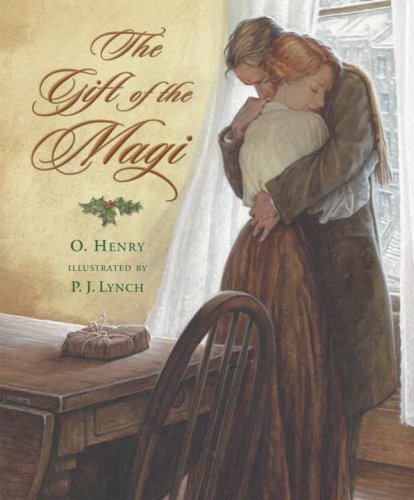
The Gift of the Magi
There was clearly nothing to do but flop down on the shabby little couch and howl. So Della did it. Which instigates the moral reflection that life is made up of sobs, sniffles, and smiles, with sniffles predominating. (That's for you, Mary Powers.)
Now, there were two possessions of the James Dillingham Youngs in which they both took a mighty pride. One was Jim's gold watch that had been his father's and his grandfather's. The other was Della's hair. Had the Queen of Sheba lived in the flat across the airshaft, Della would have let her hair hang out the window some day to dry just to depreciate Her Majesty's jewels and gifts. Had Kind Solomon been the janitor, with all his treasures piled up in the basement, Jim would have pulled out his watch every time he passed, just to see him pluck at his beard from envy.
Oh, and the next two hours tripped by on rosy wings. Forget the hashed metaphor. She was ransacking the stores for Jim's present.
She got out her curling irons and lighted the gas and went to work repairing the ravages made by generosity added to love. Which is always a tremendous task, dear friends -- a mammoth task.
"Maybe the hairs of my head were numbered, but nobody could ever count my love for you." Out of his trance Jim seemed quickly to wake. He enfolded his Della. For ten seconds let us regard with discreet scrutiny some inconsequential object in the other direction.
So, yes. Go buy the book. Or buy five copies of it. And get The Christmas Miracle of Jonathan Toomey while you're at it. Merry Christmas, friends!
Saturday, December 7, 2013
Why Comedies Make Us Sad
I remember a friend saying once that he never feels happy at Easter or Christmas, and that he gets inappropriately joyful during Lent. And I know what he meant! I realize how petulant this might sound, but I can't remember the last time I didn't feel let down at Christmas. "Is this all? Surely there must be something else." Yes, childish a thought it might well be, but I will venture to protect my dignity by saying I'm actually hitting on something deep in that dissatisfaction. And while I do experience some joy on Easter, and there have occasionally been giddy-happy Easters (really only one comes to mind), I usually feel much more at home on Good Friday and often do get that sense of a big, giant let-down come Easter Sunday.
Gillian Welch is one of my all time favorite musicians. She has a dark sort of heavy low voice and sings a lot of depressing bluegrass songs, which is why people usually turn up their noses when I say, "Oh my gosh! You don't know Gillian Welch? You have to listen to this." They listen to 30 seconds of her with a wrinkled nose and a frown, at which point I stop casting my pearls. One of her songs (not actually one of my favorites, but this one is, if you'd like to try not being a swine) has a verse in it that pretty much sums up my whole attitude about tragedies:
Now even if you don't like her voice, can we at least agree she's dead on here? There is nothing more obnoxious when you're in the pits than cheerful people. If we're feeling sad and out of it, sometimes the appropriate thing to do is wallow. Yes, under certain conditions, I approve of wallowing. And the best way to wallow is to find other wallowers. Go have "a good cry," with a marked emphasis on good.
I'm going to go a step further, and this is where you all might take issue with my position (as so many of my friends have already in conversation). Even when I'm on top of the moon, I get that little voice niggling in the back of my head saying such helpful things as, "Enjoy it while it lasts, Ellen, cause you know what's just around the corner. Everything will be back to its usual self before long." This, in short, is why comedies never really do it for me. And I'm talking about comedy in that sometimes-forgotten sense that the Greeks and other playwrights meant it; it doesn't have to be something silly -- it just has to end with order instead of chaos. I'm not saying I never cheer when the hero gets his lady-love, or that I sulk in the corner when Maleficent is thwarted and defeated (Sleeping Beauty is superb, by the way; the hero conquers "All the powers of hell" with the "Sword of Truth" allowing that "evil die and good endure.") But there is, nonetheless, that something niggling that also says, "Yes, that's all as it should be, and, you're not there yet." Comedies make us feel lonesome and dissatisfied, somewhere underneath, because they aren't true to the life we know here on earth. They highlight, they emphasize, that sense of isolation and not really belonging and wondering where on earth our place is.
And hey, that's where the problem lies. Our place isn't on earth. Of course we never feel entirely right or comfortable here. Comedies can help us by giving us a paradigm of how we should try to live, and what, in the grand scheme of things, will happen (Jesus won, by the way), but the fact of the matter is we're still in the trenches. While the universe has been claimed for The Good, we, as individuals, haven't reached that end yet. The conclusion of a proper comedy shows an ordered state where we aren't and haven't yet been. But we know in our heart of hearts we belong there. It would be decidedly odd if we could look in through that window and not get some sense of longing or yearning.
And I suppose that this is why liturgically penitential seasons make more sense to our sorry selves than the joyful ones. Perhaps our inability to experience that palpable joy is in direct proportion to our selfishness, as in, we can't bring ourselves to get over ourselves and get happy about the big picture victory. Maybe that's my problem. Because yes, Jesus has fought that fight and conquered Death for all mankind. He did it for me, too. But if my particular share in the battle were already won, I wouldn't have this daily struggle nonsense to deal with. Sometimes, the majority of the time, there's a trouble in my soul, and it's good and helpful and human for me to hear a worried song, sung by someone else who's also been down in a hole. Death shalt die. Thank you, Mr. Donne, for the future tense. We know it will happen, eventually, and we can take certain comfort in that, but we're not there yet.
And with that, here's another Gillian Welch song, quite possibly my very favorite one. The relevant words here are in the chorus (but it's all a good song):
Gillian Welch is one of my all time favorite musicians. She has a dark sort of heavy low voice and sings a lot of depressing bluegrass songs, which is why people usually turn up their noses when I say, "Oh my gosh! You don't know Gillian Welch? You have to listen to this." They listen to 30 seconds of her with a wrinkled nose and a frown, at which point I stop casting my pearls. One of her songs (not actually one of my favorites, but this one is, if you'd like to try not being a swine) has a verse in it that pretty much sums up my whole attitude about tragedies:
Now there's something good in a worried song
For the trouble in your soul.
For a worried man's been a long time down,
Down in a deep dark hole.
Now even if you don't like her voice, can we at least agree she's dead on here? There is nothing more obnoxious when you're in the pits than cheerful people. If we're feeling sad and out of it, sometimes the appropriate thing to do is wallow. Yes, under certain conditions, I approve of wallowing. And the best way to wallow is to find other wallowers. Go have "a good cry," with a marked emphasis on good.
![]() |
| Migrant Mother, by Dorothea Lange (framed with Gillian Welch in my house; I always think of them together) |
I'm going to go a step further, and this is where you all might take issue with my position (as so many of my friends have already in conversation). Even when I'm on top of the moon, I get that little voice niggling in the back of my head saying such helpful things as, "Enjoy it while it lasts, Ellen, cause you know what's just around the corner. Everything will be back to its usual self before long." This, in short, is why comedies never really do it for me. And I'm talking about comedy in that sometimes-forgotten sense that the Greeks and other playwrights meant it; it doesn't have to be something silly -- it just has to end with order instead of chaos. I'm not saying I never cheer when the hero gets his lady-love, or that I sulk in the corner when Maleficent is thwarted and defeated (Sleeping Beauty is superb, by the way; the hero conquers "All the powers of hell" with the "Sword of Truth" allowing that "evil die and good endure.") But there is, nonetheless, that something niggling that also says, "Yes, that's all as it should be, and, you're not there yet." Comedies make us feel lonesome and dissatisfied, somewhere underneath, because they aren't true to the life we know here on earth. They highlight, they emphasize, that sense of isolation and not really belonging and wondering where on earth our place is.
And hey, that's where the problem lies. Our place isn't on earth. Of course we never feel entirely right or comfortable here. Comedies can help us by giving us a paradigm of how we should try to live, and what, in the grand scheme of things, will happen (Jesus won, by the way), but the fact of the matter is we're still in the trenches. While the universe has been claimed for The Good, we, as individuals, haven't reached that end yet. The conclusion of a proper comedy shows an ordered state where we aren't and haven't yet been. But we know in our heart of hearts we belong there. It would be decidedly odd if we could look in through that window and not get some sense of longing or yearning.
And I suppose that this is why liturgically penitential seasons make more sense to our sorry selves than the joyful ones. Perhaps our inability to experience that palpable joy is in direct proportion to our selfishness, as in, we can't bring ourselves to get over ourselves and get happy about the big picture victory. Maybe that's my problem. Because yes, Jesus has fought that fight and conquered Death for all mankind. He did it for me, too. But if my particular share in the battle were already won, I wouldn't have this daily struggle nonsense to deal with. Sometimes, the majority of the time, there's a trouble in my soul, and it's good and helpful and human for me to hear a worried song, sung by someone else who's also been down in a hole. Death shalt die. Thank you, Mr. Donne, for the future tense. We know it will happen, eventually, and we can take certain comfort in that, but we're not there yet.
And with that, here's another Gillian Welch song, quite possibly my very favorite one. The relevant words here are in the chorus (but it's all a good song):
We cannot have all things to please us
No matter how we try
Until we've all gone to Jesus
We can only wonder why.
House-keeping:
- I've been redrafting some of the more popular posts from here for my writing duties over at Dappled Things blog (Deep Down Things) on the 3rd and 21st of every month. So, if you want a chance to revisit some old discussions, and see what other people are writing about, amble over.
- I've got about a week left in the semester. Please say a prayer or two that I finish all my work in time!
- I'm more sorry than you know that the frequency and sometimes the thoughtfulness of my posts here have declined. Unfortunately, things being what they are, I'm afraid that won't change any time soon. I have many things I would like to write about for you all (I carry a list around with me these days entitled "Blog Ideas to Develop") but I have that whole "Be responsible; do your work" voice niggling along with all the others. Lots of voices in this head . . .
Monday, November 25, 2013
Dappled Things and Other Things
I don't think I've yet mentioned here that I started work as an assistant editor for Dappled Things in early September. Most of you might know that magazine already. If you don't, check out their website. Oh yeah, and their blog, because, you see, I get to help with that, too!
I get to do lots of stuff for them like sorting submissions, recommending which pieces deserve further consideration, discussing and voting on final acceptance, and then editing the work when it's been accepted and getting in touch with authors about making any necessary changes. I've really enjoyed the work, even on top of my regular job and school and choir, because it makes me think seriously about the kind of writing I like to think about, and it gets me in touch with some really fantastic people. Also, it turns out that two of the guys I knew in college, Chris Petter and David Harman, do work for them as well. As a result, I get to feel very smug about my alma mater; who doesn't love that?!

All the behind-the-scenes work for the magazine is done online, which is how it can be staffed with people from all over the place -- and I'm talking from different countries, not just Montana or Virginia. Another awesome thing about it is that it's a hardcore non-profit, meaning we all do the work because we love it and believe in it; no paychecks involved. Don't get me wrong. I would be ever so happy to get an extra paycheck every once in a while. But, it also makes me happy to do this work, paycheck or no.
Our founder, Bernardo Aparicio Garcia, recently sent out a short fundraising video and asked the staff if we could spread it around (printing and distribution costs add up, you know). He talks about the mission of the magazine, the role of beauty in our culture, and what we can do in the world of art to rededicate modernity to its proper end. So give it a look-see, wander over to the fundraising page, and think about what you might do.
I'll leave you today with some words from Gerard Manley Hopkins, as it is his poem, Pied Beauty, that was the inspiration for the name of this magazine. I've been thinking a lot this last month about the relationship between joy and sorrow, and our attraction to sad things, and why we sometimes experience desolation when reason tells us we should be joyful. Hopefully, that will come out as a full-length blog post before too long. In the meantime:
What would the world be, once bereft
Of wet and wildness? Let them be left,
Oh let them be left, wildness and wet;
Long live the weeds and the wilderness yet.
-Inversnaid
![]() |
| Yours truly hiking near Inversnaid, June 2011 |
Saturday, November 16, 2013
Reflections on Reflections
(Shocking disclosure, in case you hadn't picked up on this already: I'm a Catholic.)
I was saying the rosary a couple of weeks ago, and I noticed the shadow of some of the beads on the pew. In a generous estimation, I think I'm maybe at a 2% successful meditation status for the rosary; this day was no different. I started looking at the shadow because it was so pretty. I was really good at focusing on that shadow. There was something attractive, or, shall we say, entrammeling about it. I spent the next little while going over it in my mind, and trying to figure out why I liked the shadow so much more than the rosary in my hand. Because really, though I say it myself, I do have a be-yoo-ti-ful rosary.
This question prompted other questions.
People are all about imitation. That's certainly part of it. There's a fruitfulness, a richness, and a reminder of the power of creation (which is, mind-blowingly, a partly human power) in every copy of something real. As for kids playing make-believe:
We are powerful. We are the privileged of all God's creations. And men and women are beautiful creatures, physically and spiritually. And that spiritual part, that part we can't disect and touch and put band-aids on, that part we can't fully understand and that sometimes scares the you-know-what out of us, is a good enough excuse for us to try to hide from reality. Shadows, excessive pictures, escapist novels and grown-up make-believe can all become and often are a way of hiding from real life. Some plausible answers to that list of questions:
1. What's the deal with shadows?
I should have been dwelling on the mysteries of the Incarnation and the Redemption of the world. But instead, I was looking at the poor copy of beads that help me count to ten, because I can't even stay focused long enough to do that five times on my own. Way to go, Ellen. Now, more seriously, we're fascinated with them because they are a reminder of our creative power; our shadows can't exist without us, and they'll copy every single thing that we do. And they keep us company all the time. They must really love us, right? So we love them. Just ask Peter Pan.
2. And pictures?
How many times have you heard: can you please just put the camera down? Or have you been to a wedding where you were asked not to take pictures during the ceremony? Too much of the time, our efforts to record reality end up distracting us from reality. We see through a glass dimly.
3. And mirrors?
Usually I take a baby to a mirror when he's crying. I show him my hand in front of the mirror, and then hold up his hand, and let him see how his mirror-hand and my mirror-hand mimic our real hands. Almost without fail, this stops him from crying, makes him forget about whatever made him upset, at least for a little while. But fascination with mirrors is a dangerous thing, isn't it? Don't forget Narcissus, or the mirror in the Harry Potter books that destroys men with longing and divorces them from reality, or, for that matter, the mirror of Snow White's wicked stepmother.
4. And children's games . . .
Children playing make-believe is a good thing. Stretching their imaginations, learning to think of ways and possibilities outside of their immediate reality, and sometimes connecting their own selves to great archetypes that they'll learn to follow and live up to, all help them to be better people. But even children can use their imaginations to escape from reality in less than innocent ways (yes, I'm talking about lying little mischief-makers). Eventually, though, children grow up, and they'll have to stop living in a world of make-believe, steady the rocking horse, and find out what the heavy book says.
5. Books and movies.
Grown-ups (?) who live in novels and movies, even if they're good ones, are living in a fabricated world. They are the children who never figured out what the imagination is actually for. Imitation of something real is good, but only if it makes you think about the real thing in a new light, not if it's such a paltry or misused imitation that it makes you forget, or wish you could forget, what is actually real.
6. The Troglodytes.
So, Plato's cave-dwellers, chained and watching those images, divorced from reality, thinking they know what is real, unwilling to hear that what they see is a shadowy imitation and not the real article at all, well, that's us, isn't it. They're focusing on what they wish were real, on what they have convinced themselves is real. But if they want to be grown-ups, one day they're going to have to break the chains, stop fooling themselves, and actually come face to face with real truth. A lot of things look real enough, are vague enough and ill-defined enough that we can make of them whatever we need to be comfortable with them. But they're only weak, insubstantial and paltry imitations of what we're really made for.
Reflections, games, books, stories, pictures and art are all good things, oftentimes beautiful things, which is why we like them. But they're not it. They're copies. So don't stop there. Stop when you find out what they're copying, and, more importantly, why it's worth being copied.
I was saying the rosary a couple of weeks ago, and I noticed the shadow of some of the beads on the pew. In a generous estimation, I think I'm maybe at a 2% successful meditation status for the rosary; this day was no different. I started looking at the shadow because it was so pretty. I was really good at focusing on that shadow. There was something attractive, or, shall we say, entrammeling about it. I spent the next little while going over it in my mind, and trying to figure out why I liked the shadow so much more than the rosary in my hand. Because really, though I say it myself, I do have a be-yoo-ti-ful rosary.
This question prompted other questions.
- What's the deal with shadow puppets? and other shadow games?
- Why are we obsessed with taking pictures?
- Why do babies like mirrors?
- Why do children play make-believe?
- Why do we like books, movies, or other forms of art?
- What are the troglodytes focusing on inside Plato's cave?
People are all about imitation. That's certainly part of it. There's a fruitfulness, a richness, and a reminder of the power of creation (which is, mind-blowingly, a partly human power) in every copy of something real. As for kids playing make-believe:
Notes on ImaginationI have a special place in my heart for that poem; it was the first thing of mine I ever saw in print for distribution, and it has a great back story (thank you, Joshua Neu). I bring it up now, though, because I think it gets right to the heart of all these questions.
There must be a reason to children's building
castles out of blankets,
a reason they're the masters of all
they see, without self-conscious
inhibitions.
Are they bridging a vast native gap
as they scale imaginary forts, or is it
merely a blanket, held
down on a rocking horse with a heavy book
they can't read?
We are powerful. We are the privileged of all God's creations. And men and women are beautiful creatures, physically and spiritually. And that spiritual part, that part we can't disect and touch and put band-aids on, that part we can't fully understand and that sometimes scares the you-know-what out of us, is a good enough excuse for us to try to hide from reality. Shadows, excessive pictures, escapist novels and grown-up make-believe can all become and often are a way of hiding from real life. Some plausible answers to that list of questions:
1. What's the deal with shadows?
I should have been dwelling on the mysteries of the Incarnation and the Redemption of the world. But instead, I was looking at the poor copy of beads that help me count to ten, because I can't even stay focused long enough to do that five times on my own. Way to go, Ellen. Now, more seriously, we're fascinated with them because they are a reminder of our creative power; our shadows can't exist without us, and they'll copy every single thing that we do. And they keep us company all the time. They must really love us, right? So we love them. Just ask Peter Pan.
2. And pictures?
How many times have you heard: can you please just put the camera down? Or have you been to a wedding where you were asked not to take pictures during the ceremony? Too much of the time, our efforts to record reality end up distracting us from reality. We see through a glass dimly.
3. And mirrors?
Usually I take a baby to a mirror when he's crying. I show him my hand in front of the mirror, and then hold up his hand, and let him see how his mirror-hand and my mirror-hand mimic our real hands. Almost without fail, this stops him from crying, makes him forget about whatever made him upset, at least for a little while. But fascination with mirrors is a dangerous thing, isn't it? Don't forget Narcissus, or the mirror in the Harry Potter books that destroys men with longing and divorces them from reality, or, for that matter, the mirror of Snow White's wicked stepmother.
4. And children's games . . .
Children playing make-believe is a good thing. Stretching their imaginations, learning to think of ways and possibilities outside of their immediate reality, and sometimes connecting their own selves to great archetypes that they'll learn to follow and live up to, all help them to be better people. But even children can use their imaginations to escape from reality in less than innocent ways (yes, I'm talking about lying little mischief-makers). Eventually, though, children grow up, and they'll have to stop living in a world of make-believe, steady the rocking horse, and find out what the heavy book says.
5. Books and movies.
Grown-ups (?) who live in novels and movies, even if they're good ones, are living in a fabricated world. They are the children who never figured out what the imagination is actually for. Imitation of something real is good, but only if it makes you think about the real thing in a new light, not if it's such a paltry or misused imitation that it makes you forget, or wish you could forget, what is actually real.
6. The Troglodytes.
So, Plato's cave-dwellers, chained and watching those images, divorced from reality, thinking they know what is real, unwilling to hear that what they see is a shadowy imitation and not the real article at all, well, that's us, isn't it. They're focusing on what they wish were real, on what they have convinced themselves is real. But if they want to be grown-ups, one day they're going to have to break the chains, stop fooling themselves, and actually come face to face with real truth. A lot of things look real enough, are vague enough and ill-defined enough that we can make of them whatever we need to be comfortable with them. But they're only weak, insubstantial and paltry imitations of what we're really made for.
Reflections, games, books, stories, pictures and art are all good things, oftentimes beautiful things, which is why we like them. But they're not it. They're copies. So don't stop there. Stop when you find out what they're copying, and, more importantly, why it's worth being copied.
Thursday, October 31, 2013
The Keats Quiz
How well do you know him? In honor of his birthday, I've made up a quiz for you all. (Yes, this is what I was thinking about lying awake at midnight last night when I should have been asleep; I hope you're grateful.) I don't know how to do the fancy actual multiple choice thing where you skip ahead to a new page for each question, so please do bear with my stone-age tactics. No looking up answers, all you cheaters out there! Honor system, please. And then, find out where you rank and what your score indicates about you.
1. Keats was:
A. Irish
B. Scottish
C. English
D. Welsh
2. The lady with whom he was in love when he wrote Bright Star was:
A. Fanny Brawne
B. Fanny Price
C. Fanny Dashwood
D. His mom
3. The disease which claimed him (and several of his family members) was:
A. Typhoid
B. Tuberculosis
C. Tendinitis
D. Love
4. Before he gave himself over to the muse of poesy, Keats studied to be a(n):
A. Apothecary
B. Barrister
C. Librarian
D. Farrier
5. At the age of 25, Keats died in a small apartment in Rome overlooking the:
A. Roman Forum
B. Tiber River
C. Vatican Gardens
D. Spanish Steps
Name that poem!
6. "Silent, upon a peak in Darien."
A. Ode to a Nightingale
B. Ode on a Grecian Urn
C. On first looking into Chapman's Homer
D. Endymion
E. Bright Star
F. When I have fears that I may cease to be
7. "Forever wilt thou love, and she be fair."
A. Ode to a Nightingale
B. Ode on a Grecian Urn
C. On First Looking into Chapman's Homer
D. Endymion
E. Bright Star
F. When I have fears that I may cease to be
B. Ode on a Grecian Urn
C. On First Looking into Chapman's Homer
D. Endymion
E. Bright Star
F. When I have fears that I may cease to be
9. "Darkling I listen, and for many a time I have been half in love with easeful death. . ."
A. Ode to a Nightingale
B. Ode on a Grecian Urn
C. On First Looking into Chapman's Homer
D. Endymion
E. Bright Star
F. When I have fears that I may cease to be
10. ". . . before my pen has glean'd my teeming brain. . ."
A. Ode to a Nightingale
B. Ode on a Grecian Urn
C. On First Looking into Chapman's Homer
D. Endymion
E. Bright Star
F. When I have fears that I may cease to be
Extra Credit: Arguably what he is most remembered for, he developed the poetic technique of (fill in the two blanks), something he discussed in detail in one of his letters to his brothers George and Tom: "... that is, when man is capable of being in uncertainties, mysteries, doubts, without any irritable reaching after fact and reason" (21 Dec 1817).
So, how did you do?
Answer key:
1-C; 2-A; 3-B; 4-A; 5-D; 6-C; 7-B; 8-D; 9-A; 10-F
Extra Credit: Negative Capability
And what does your score mean?
0-1: Go back to kindergarten!
2-3: You're lazy, but passably intelligent.
4-6: You passed high school English
7-10: You either were an English major or should have been one.
11: Grad school isn't good enough for you.
Happy Birthday, Mr. Keats.
1. Keats was:
A. Irish
B. Scottish
C. English
D. Welsh
2. The lady with whom he was in love when he wrote Bright Star was:
A. Fanny Brawne
B. Fanny Price
C. Fanny Dashwood
D. His mom
3. The disease which claimed him (and several of his family members) was:
A. Typhoid
B. Tuberculosis
C. Tendinitis
D. Love
4. Before he gave himself over to the muse of poesy, Keats studied to be a(n):
A. Apothecary
B. Barrister
C. Librarian
D. Farrier
5. At the age of 25, Keats died in a small apartment in Rome overlooking the:
A. Roman Forum
B. Tiber River
C. Vatican Gardens
D. Spanish Steps
Name that poem!
6. "Silent, upon a peak in Darien."
A. Ode to a Nightingale
B. Ode on a Grecian Urn
C. On first looking into Chapman's Homer
D. Endymion
E. Bright Star
F. When I have fears that I may cease to be
7. "Forever wilt thou love, and she be fair."
A. Ode to a Nightingale
B. Ode on a Grecian Urn
C. On First Looking into Chapman's Homer
D. Endymion
E. Bright Star
F. When I have fears that I may cease to be
8. "A thing of beauty is a joy forever. . . it will never pass into nothingness."
A. Ode to a NightingaleB. Ode on a Grecian Urn
C. On First Looking into Chapman's Homer
D. Endymion
E. Bright Star
F. When I have fears that I may cease to be
9. "Darkling I listen, and for many a time I have been half in love with easeful death. . ."
A. Ode to a Nightingale
B. Ode on a Grecian Urn
C. On First Looking into Chapman's Homer
D. Endymion
E. Bright Star
F. When I have fears that I may cease to be
10. ". . . before my pen has glean'd my teeming brain. . ."
A. Ode to a Nightingale
B. Ode on a Grecian Urn
C. On First Looking into Chapman's Homer
D. Endymion
E. Bright Star
F. When I have fears that I may cease to be
Extra Credit: Arguably what he is most remembered for, he developed the poetic technique of (fill in the two blanks), something he discussed in detail in one of his letters to his brothers George and Tom: "... that is, when man is capable of being in uncertainties, mysteries, doubts, without any irritable reaching after fact and reason" (21 Dec 1817).
So, how did you do?
Answer key:
1-C; 2-A; 3-B; 4-A; 5-D; 6-C; 7-B; 8-D; 9-A; 10-F
Extra Credit: Negative Capability
And what does your score mean?
0-1: Go back to kindergarten!
2-3: You're lazy, but passably intelligent.
4-6: You passed high school English
7-10: You either were an English major or should have been one.
11: Grad school isn't good enough for you.
![]() |
| Fanny Brawne and the man himself. |
Happy Birthday, Mr. Keats.
Monday, October 21, 2013
Shakespeare's English and Various Notes
Have you all seen this video yet?
Believe it or not, I'd be happy to marry into this family. Man, what a life.
Other exciting things:
Believe it or not, I'd be happy to marry into this family. Man, what a life.
Other exciting things:
- I'm relatively certain I passed my bio midterm. Also, a midterm with no essays? What world is this?
- I've been working on the staff of Dappled Things Literary Magazine for almost two months now. I get to blog for them! And edit for them! And sort submissions! It's lots of fun. Two of my fellow UD graduates are also on the staff, which makes me all kinds of proud of my alma mater.
- I joined a writing group. Tomorrow they're critiquing something I wrote. Am I nervous? What do you think?
- An interesting reflection on language barriers from one of my little brothers: He's at a French seminary in Florence. Although many of the seminarians do speak English, it is preferred that everyone speak French. He's gotten to the point where he can understand it, and he can speak it well enough most of the time. But he said that when he hears people speaking French, he doesn't hear distinctions of voices; he just hears French. In English, he can hear variations and inflections and tones of voice that open up someone's character in a way that can't be done when he's listening to a foreign language. He didn't realize this was happening until one of the French seminarians started speaking English to a visitor. Not only was this the first time that he'd heard him speak English, but he said it was also the first time he heard his voice. Quite suddenly he had a much fuller, richer understanding of who his fellow student is. And this is another reason I love language.
Monday, October 7, 2013
Your Festering Prayer Life
I picked up The Screwtape Letters again over the weekend. If you're not familiar with them, they are what I think to be one of CS Lewis' more ingenious scenarios: an uncle demon who is well-practiced in his trade giving advice to his nephew, a junior tempter. I mean, really, what a marvelous idea.
My roommate and I were discussing the third letter. In addition to what you might glean from the following excerpts, remember her words of wisdom on the subject; those "daily pinpricks" and "unendurable irritations" are cemented as such when the two people don't talk to each other about them, either out of fear of confrontation, or from some misguided attempt to "be noble" and "offer it up" and view the other person as "a source of constant mortification." Correct me if I'm wrong, but it seems that holding your spouse/sibling/roommate/parent in the same category that you do a medieval flagellum is not the way to love and respect them. A personality can be a mortification; we all have those individuals in our lives who "rub us the wrong way" with whom we just don't "mesh" (I'm using a lot of quotation marks -- sorry). But somebody you live with, rather than that person who runs in the same social circles and whom you should maybe just try to avoid, cannot remain in that box of "the person who exists to get me to heaven faster because they're so annoying." (And yes, I do realize that no one should be in that box. But if you're going to start getting people out of it, start with the people you live with.)
Confront them. Talk to them. Work it out. Realize that you're annoying, too. Don't let hatred fester in your "prayers." (I don't have it all figured out, either, just so we're clear. A note on my list of classes for this year: "COMM 114: Communication Skills - still required." Ouch.)
My dear Wormwood,
I am very pleased by what you tell me about this man's relations with his mother. Keep in close touch with our colleague Glubose who is in charge of [her], and build up between you in that house a good settled habit of mutual annoyance; daily pinpricks. The following methods are useful:
1. Keep his mind off the most elementary duties by directing it to the most advanced and spiritual ones. Aggravate that most useful human characteristic, the horror and neglect of the obvious. You must bring him to a condition in which he can practise self-examination for an hour without discovering any of those facts about himself which are perfectly clear to anyone who has ever lived in the same house with him or worked in the same office.
2. It is, no doubt, impossible to prevent his prayer for his mother, but we have means of rendering the prayers innocuous. Make sure that they are always very 'spiritual', that he is always concerned with the state of her soul and never with her rheumatism. His attention will be kept on what he regards as her sins, by which, with a little guidance from you, he can be induced to mean any of her actions which are inconvenient or irritating to himself. Thus you can keep rubbing the wounds of the day a little sorer even while he is on his knees; the operation is not at all difficult and you will find it very entertaining.
3. When two humans have lived together for many years it usually happens that each has tones of voice and expressions of face which are almost unendurably irritating to the other. Work on that. Bring fully into the consciousness of your patient that particular lift of his mother's eyebrows which he learned to dislike in the nursery, and let him think how much he dislikes it. Let him assume that she knows how annoying it is and does it to annoy -- if you know your job he will not notice the immense improbability of the assumption. And, of course, never let him suspect that he has tones and looks which similarly annoy her. As he cannot see or hear himself, this is easily managed.Bear in mind, if you find yourself prompted to return to this "collection of letters" or to pick it up for the first time, what Lewis warns in his preface:
Your affectionate uncle
SCREWTAPE
There are two equal and opposite errors into which our race can fall about the devils. One is to disbelieve in their existence. The other is to believe, and to feel an excessive and unhealthy interest in them. They themselves are equally pleased by both errors and hail a materialist or a magician with the same delight.Evil is real and actively working to capture you. Be careful how and why you choose to grow in your understanding of it.
Wednesday, September 25, 2013
Marriage Lies and Mrs. Mike
One of the most common misunderstandings of marriage, and romantic relationships in general, is that you should never have to change yourself for the one you're with. Be yourself. Don't compromise who you are. Don't let him change you. If you have to change to be happy with him, he's not worth it and he doesn't deserve you.
The thing is, to a certain degree, all of those things are true. But it all depends on how you go about it. Yes, you should be yourself. Yes, you shouldn't allow someone else to forcibly compromise who you are. You shouldn't let him change you. But what it the best version of being yourself? Being someone who chooses to change for someone else. Being someone who sacrifices their own will for the sake of another. Being the you that changes for him.
(Pronouns - I'm a woman, so I'm writing from a woman's perspective. Guys, in case you're wondering, you have to choose to change for her, too. It's a two-way street.)
A few years ago, on one of my visits to see my Sister sister in the convent, I was having tea in the kitchen with one or two of the older Sisters. One of them asked me, "So, sweetie, do you think you might have a religious vocation, too?" "Well, no, not really, Sister." "So, then, tell me about the men in your life!" And suddenly there were five or six bright-eyed cheery little old Sisters gathered around me, giving me dating advice from their walkers. What a situation. One piece of advice has stuck with me, though, not because I necessarily have any control over it, but because of the wisdom nugget in there: "Well, dear, just make sure you don't wait too long. If you do, you'll be too set in your own ways and you'll never be able to change enough for each other. You have to grow up together, you know."
Have you ever read Mrs. Mike? It's one of those books that my sisters and I read a million times over in high school. I picked it up again recently because I don't have to give it much thought. Is it "high literature"? Well, no. But it's an easy read, and a really really good read. The heroine is Katherine Mary O'Fallon, a young woman from a Boston-Irish family who goes to live with her uncle in the Canadian wilderness. She ends up marrying Sergeant Mike Flannigan, leaving her family in Boston, and travelling far out into the frozen tundra to live with her new husband. As you might imagine, it is not an easy adjustment, and at one point she has a bit of a nervous breakdown. Mike is worried for her, and tells her that night that he's taking her back east in the morning; they'll work something else out together. But here's what happens:Mike and I lay awake with our own thoughts. And in the morning he took me on, not back. It was that night that I really became his wife, for I knew that this white land and its loneliness were a part of Mike. It was a part I feared, that I didn't know or understand. But I knew that I had to know it and understand it, and even love it as Mike did. Because I wanted to be like Mike and then, after our lives had been lived, maybe I'd be Mike.
When he held me, we were crushed into one, one body with one heart beating through us. And that's the way it had to be with our minds and our feelings. It was much harder because they get tangled in thoughts and caught in emotions. But in the end that's the way it had to be.
So I lay there, my second night in Taylor's Flat, and told myself, "If you love Mike, you'll love the things that go with him. And if you can't love them, you'll understand them -- and until you do you'll keep the fight to understand them in yourself, and not be carrying on and worrying him like you did tonight." I was cold and trembling under my covers for fear I'd talked to myself too late, that Mike would really send me back.
But Mike must have been talking to himself as hard as I was to myself, and he must have decided that I was still worth the trouble I caused, because in the morning he said nothing about sending me home.
One night cannot dispose of a feeling or settle an attitude, and many a night on the way up to Hudson's Hope I had to fight back the thoughts of my home and my mother and the tears that came with them. Yet, it was a happy time and an exciting one, full of love and adventure and a new life opening up. The fears grew smaller, and all they could do was peck at my happiness.
Mike told me I was stronger. I knew I was. "And you've adjusted quickly in a country that is usually too hard for women." He was proud of me, and he acted proud in front of the men because where were their wives?It's easy to crush bodies together. Melding minds and feelings into a unified one is a little trickier. But that's what's got to happen. Time for a platitude that we all keep forgetting: Love is sacrifice. It means cutting bits of yourself off because something else is more important than those bits. So get to it.
Tuesday, September 17, 2013
Wiseblood Books
Confession: I don't get short stories. Poems, by and large, are short snippets, a steady, heavy look at one big thought, saying one thing concisely. Novels create a whole world, an extended universe. However, as I've said to some of my friends, when I think of short stories, I see teenage chickens.
Yes. Teenage chickens. Newly hatched chicks are one of the sweetest things in the whole wide world. Grown up chickens, while they might be rivaled only by sheep in their level of stupidity, and by pigs in their stench, nonetheless have a certain dignity. But no one ever talks about the in-between-chicken. He is an ungainly creature. And that is my frustration with short stories.
I am, of course, frustrated by my frustration, because there are authors whom I adore, such as Flannery O'Connor, who wrote lots and lots of short stories. I've tried. Really I have. And if bourbon and good company and reading them out loud together can only muster feelings of mild appreciation rather than a delighted insatiable desire for more, well, then I guess I'm stuck. So I decided years ago to increase my acquaintance with O'Connor by reading Wiseblood, one of her two novels.
Like Faulkner and Cormac McCarthy, she'll make your head spin as you attempt to decipher simple plot lines. Like Graham Greene and Robert Penn Warren, she'll make you feel sticky and dirty in the heat and the dust. And like Walker Percy, she'll put you at your ease and discomfit you all at the same time by how unfortunately true her writing is:
Like I said, it was several years ago that I read Wiseblood, but she's been on my mind lately because, have you heard? Farrar, Straus and Giroux are publishing one of her journals! There is an article in the The New Yorker that has some long excerpts from it; I recommend whetting your appetite. Is it outrageous for me to say that part of the reason I'm so excited about this is that I identify with her? Let me explain; she's a young woman trying to figure out how and why and what to write, and wants desperately to do well at it and do it for the right reasons:
In all my searching and excitement for this book release, I came across another publisher who seems to be on the right track. Look into Wiseblood Publishing; they're doing a good thing.
I'm afraid that's all I've got for you today. I started my midwifery training three weeks ago, and my time and head are full of bio flashcards, placentas, and the distinctions between APA and MLA citations. Which I like! But, you know, not everybody wants to read about placentophagy. I'll spare you the details.
Yes. Teenage chickens. Newly hatched chicks are one of the sweetest things in the whole wide world. Grown up chickens, while they might be rivaled only by sheep in their level of stupidity, and by pigs in their stench, nonetheless have a certain dignity. But no one ever talks about the in-between-chicken. He is an ungainly creature. And that is my frustration with short stories.
I am, of course, frustrated by my frustration, because there are authors whom I adore, such as Flannery O'Connor, who wrote lots and lots of short stories. I've tried. Really I have. And if bourbon and good company and reading them out loud together can only muster feelings of mild appreciation rather than a delighted insatiable desire for more, well, then I guess I'm stuck. So I decided years ago to increase my acquaintance with O'Connor by reading Wiseblood, one of her two novels.
Like Faulkner and Cormac McCarthy, she'll make your head spin as you attempt to decipher simple plot lines. Like Graham Greene and Robert Penn Warren, she'll make you feel sticky and dirty in the heat and the dust. And like Walker Percy, she'll put you at your ease and discomfit you all at the same time by how unfortunately true her writing is:
"That's the trouble with you preachers," he said. "You've all got too good to believe in anything," and he drove off with a look of disgust and righteousness.
Like I said, it was several years ago that I read Wiseblood, but she's been on my mind lately because, have you heard? Farrar, Straus and Giroux are publishing one of her journals! There is an article in the The New Yorker that has some long excerpts from it; I recommend whetting your appetite. Is it outrageous for me to say that part of the reason I'm so excited about this is that I identify with her? Let me explain; she's a young woman trying to figure out how and why and what to write, and wants desperately to do well at it and do it for the right reasons:
"Please help me dear God to be a good writer and to get something else accepted. . . Don't let me ever think, dear God, that I was anything but the instrument for Your story."
In all my searching and excitement for this book release, I came across another publisher who seems to be on the right track. Look into Wiseblood Publishing; they're doing a good thing.
I'm afraid that's all I've got for you today. I started my midwifery training three weeks ago, and my time and head are full of bio flashcards, placentas, and the distinctions between APA and MLA citations. Which I like! But, you know, not everybody wants to read about placentophagy. I'll spare you the details.
Thursday, September 5, 2013
The Millennial Little Women
I watched Little Women with one of my roommates last night. Both of us are at the point where we've seen it so many times that it's difficult not to recite it as we watch it, and bits and pieces of the script come up in every day conversation on an alarmingly regular basis. This is the roommate with whom, in college, I watched this whole movie in ten minute segments on youtube on her phone. I've been told this means we're addicts; I prefer to think of us as budget-restricted devotees.
It had been a while, though, since the last time I saw it, so of course lines that I thought I knew suddenly made new sense; I heard different things than I've heard before. Besides, I think I used to be a Beth, and it's possible that I morphed into a Jo somewhere during the last 5 years.

The part that really got me is when she's talking with her mother after telling her dearest friend that no, she doesn't want to marry him. She's fretful and unhappy and feeling lost and confused, and it doesn't help matters that her aunt has taken her little sister to Europe instead of taking her:
Well, not exactly.
If I had twelve sons, I might name every one of them Augustine. (Kidding. Maybe.) Born in 354, he didn't figure out his life till he was 32. In his own words, with my emphasis added,
Go another 500 years. A wild Spanish knight named Ignatius is wounded in battle, and has to lie in bed for months waiting for his leg to heal up. Bored out of his mind, the 31 year old picks up the book someone left on his nightstand. Thus, in 1521, were the Jesuits born, totally kick-ass missionaries of Christ imbued with a soldier's love of discipline and order. Have you seen The Mission, starring Robert De Niro, Liam Neeson, and Jeremy Irons? Go watch it, and thank Ignatius of Loyola for what he started. (And maybe ask him to help get the Jesuits back to their former glory; they've hit a bit of a rough patch.)
So, I have two things to say to you, my fellow millennials.
First, get over yourself. Your challenges are really nothing special in terms of the scope of the universe and all the people who have lived here and what they've had to deal with and figure out. Everybody has to fight against something to know his own place. If we didn't, why then how weary, stale, flat and unprofitable would seem to us all the uses of this world (name that play!). Warning: sometimes they (those uses) will seem that way anyway. For example, bear in mind that figuring it out might take being imprisoned (St. Francis) or getting your leg mauled and lying on your back for a year (St. Ignatius). Get used to the idea, and buck up.
Second, you yourself are actually something pretty special. God never made anybody with the thought, "Now I will create a thoroughly mediocre individual whose highest possible level of accomplishment is unenthralled complacency." If you are anything like the rest of us, which you are, you'll hit that moment of crisis comparable to Jo's. A good life was offered to her; a man she loved, one of her dearest friends for years, asked her to marry him. But she knew it wasn't right, somehow. She didn't know what was; all she knew was that she was fitful and felt awkward and ugly and out of place and had to do something not that. Luckily for Jo, she had a wonderful mother who told her the right thing. She was meant for extraordinary things. She had talent, she had desire, she had passion, and she had an intellect. She didn't take the first thing that was offered simply because it was offered and seemed like a "good enough" idea. She went out to test herself and to make her fortune in the world -- and that is a story as old and lasting as the hills.
Millennials, your existential crises are nothing more or less than the eternal plight of the human condition. You have a multitude of comrades in the battle. Rise to meet it, revel in it, and be something extraordinary.
It had been a while, though, since the last time I saw it, so of course lines that I thought I knew suddenly made new sense; I heard different things than I've heard before. Besides, I think I used to be a Beth, and it's possible that I morphed into a Jo somewhere during the last 5 years.

The part that really got me is when she's talking with her mother after telling her dearest friend that no, she doesn't want to marry him. She's fretful and unhappy and feeling lost and confused, and it doesn't help matters that her aunt has taken her little sister to Europe instead of taking her:
"Of course Aunt March prefers Amy over me. Why shouldn't she? I'm ugly and awkward, and I always say the wrong thing. I fly around, throwing away perfectly good marriage proposals! I love our home, but I'm just so fitful that I can't stand being here! I'm sorry - I'm sorry, Marmee - there's just something really wrong with me. I want to change, but I can't. . . and I just know I'll never fit in anywhere."
"Jo. You have so many extraordinary gifts! How can you expect to lead an ordinary life? You're ready to go out and find a good use for your talent. Although, I don't know what I shall do without my Jo. Go, and embrace your liberty, and see what wonderful things come of it."Okay, I know this is a sentimental movie. But oh my goodness, is it just me, or is this the eternal story of the flustered 20-something? It's not news that every generation has their own challenges, and that they think that their set of challenges is bigger and more monumental than the challenges any other generation has faced before. Ever. And this is what I keep hearing about my own generation, those of us who have been dubbed, "The Millennials." We're hopelessly floundering around our 20's, with little direction, mediocre accomplishments and nothing to be proud of or to hold on to. And no one has ever been so lost as we are now, right?
Well, not exactly.
If I had twelve sons, I might name every one of them Augustine. (Kidding. Maybe.) Born in 354, he didn't figure out his life till he was 32. In his own words, with my emphasis added,
Late have I loved you, Beauty so ancient and so new, late have I loved you. You were within, but I outside, seeking there for you, and upon the shapely things you have made, I rushed headlong, I, misshapen. . . You called, shouted, broke through my deafness; you flared, blazed, banished my blindness; you lavished your fragrance. sourceFast forward almost 900 years. In 1181, a cloth merchant's wife gives birth to a boy whom he names Francesco. He's fairly well spoiled, likes throwing crazy parties as much as Augustine did, and wants adventure in the great world. His big turn around happened gradually during his mid-twenties, and what a turn around it was. Luckily for Francis of Assisi, he didn't end up living too long; he did a good job of making an ascetically penitential life for himself, and earned, as far as I can tell, an early retirement.
Go another 500 years. A wild Spanish knight named Ignatius is wounded in battle, and has to lie in bed for months waiting for his leg to heal up. Bored out of his mind, the 31 year old picks up the book someone left on his nightstand. Thus, in 1521, were the Jesuits born, totally kick-ass missionaries of Christ imbued with a soldier's love of discipline and order. Have you seen The Mission, starring Robert De Niro, Liam Neeson, and Jeremy Irons? Go watch it, and thank Ignatius of Loyola for what he started. (And maybe ask him to help get the Jesuits back to their former glory; they've hit a bit of a rough patch.)
So, I have two things to say to you, my fellow millennials.
Second, you yourself are actually something pretty special. God never made anybody with the thought, "Now I will create a thoroughly mediocre individual whose highest possible level of accomplishment is unenthralled complacency." If you are anything like the rest of us, which you are, you'll hit that moment of crisis comparable to Jo's. A good life was offered to her; a man she loved, one of her dearest friends for years, asked her to marry him. But she knew it wasn't right, somehow. She didn't know what was; all she knew was that she was fitful and felt awkward and ugly and out of place and had to do something not that. Luckily for Jo, she had a wonderful mother who told her the right thing. She was meant for extraordinary things. She had talent, she had desire, she had passion, and she had an intellect. She didn't take the first thing that was offered simply because it was offered and seemed like a "good enough" idea. She went out to test herself and to make her fortune in the world -- and that is a story as old and lasting as the hills.
Millennials, your existential crises are nothing more or less than the eternal plight of the human condition. You have a multitude of comrades in the battle. Rise to meet it, revel in it, and be something extraordinary.
Wednesday, August 28, 2013
Calligraphy Projects - Pictures!
I started out by copying the shapes of the letters of other calligraphy that I had seen and liked. Of course, working with a mechanical pencil and lined legal pad is hardly the proper way to go, but I figured I'd start cheap and work my way into the pricier materials as I figured out what I was doing:
I wanted some sort of symbolic motif worked into the capital letters, hence the grape vines. As it turned out, in the end I found something I liked better. This is why we practice, right? Eventually, I moved onto uni-ball black pens and printer paper and I continued to experiment with the shapes of letters. I'm still not satisfied with the final outcome of some of them, but it makes for pretty scratch paper:
I wasn't sure initially which colors I wanted to incorporate, especially as I hadn't done any shopping for appropriate pens and markers, and was only working with what I had in my pencil cup. Green seemed like a natural choice (growth, new life, springtime, my assigned color at work and so the color pen I have most of), and in looking at images of old manuscripts it seemed pretty consistent that red and black were the colors of choice. So, ultimately I decided to use black for the majority of the text, and use red for key phrases. At this point, I was still on printer paper, and still tracing the outlines of the letters and filling them in with a pen. It was tedious.


It was about this time that one of my out-laws over at Like Mother Like Daughter (Pippo and newborn little Mary are my niece and nephew; the Captain is my older brother) had her first gorgeous little girl, Evangeline Rose. Needing to mix things up a bit and work with some different text, I went on the hunt for some appropriate scripture passages for the new baby. I melded various not-so-racy verses from several chapters of the Song of Songs, putting together a passage that wasn't too long, and seemed like the right thing for a little girl to grow up hearing. Then, of course, I had to figure out the colors and motifs appropriate for that passage.

The last line speaks of the sun and the moon, comparing the "she" in question to the beauty of each, so I knew I wanted to work in a sun and a moon. I google image searched variations on "medieval sun and moon" and "illuminated manuscript sun and moon" and came up with a hybrid melding of the two that I like pretty well. This first draft of the passage is done with highlighter (that's that garish yellow - you know, what I had in my pencil cup) on the back of a piece of lined scrap paper from my desk. I drew over the lines with a heavy dark pen so I could see them through the paper - I can't do this properly without guidelines! I traced the outline for the sun around the bottom of the mug on my desk. Not sure if I should leave the moon blue or color it over with silver, I left it half and half so I could decide on it later.
Next, I finally got myself some proper utensils. A word on those: Michael's was the natural choice for me, but I'm sure, if you want to get serious about this, probably going to a proper art supplies store is a better bet. Not feeling adequately confident enough to handle calligraphy pens with free flowing ink, I went the beginner's route and got calligraphy markers. I liked them because they came in a pack and so were the more economical way to go, and also because they had two tips to each pen. I didn't like them because the nibs of the markers, especially the black as it was the most often used, wore down and became imprecise far too quickly. That being said, I do recommend them if you're starting to learn:

I also got Faber-Castell pens in silver and gold. They don't have calligraphy tips, but they do lend that metallic sheen that I wanted in imitation of the gold-leaf that the real old manuscripts used. Having acquired the proper writing utensils, I got out a piece of my Crane & Co. stationary to see how the pens and markers would react on thicker, grainier paper. I guess I also hoped that it would maybe even possibly be a final draft.

Guess what? It wasn't a final draft. For one thing, though it doesn't show up so much here, the sun came out looking kind of green, and also way too heavy. I didn't like the "O"s at the beginnings of the sentences, there wasn't enough room on the page to write all of what I wanted to, the last sentence wasn't a question but I ended it with a question mark anyway, and the question mark didn't even look like a question mark. Back to the drawing board.
Re-estimating how much space I would need to fit in all of the text, I took out another piece of stationary, measured out the lines, and voila! It came together. There were definitely still a few little mistakes, but that's to be expected. The next step was to find a border that meant something, and one that I liked. Ultimately, I decided on a take-off of something I found in one of my all-time favorite books (found in a used book store near Dallas several years ago):
Notice anything funny on that bottom line in red? Also, did you notice how the "h" is missing from "daughter" and from every single "brought"? No, that is not antiquated spelling. That's me not paying attention. And then I was having a conversation with my roommates as I was finishing it up, hence distraction-induced repeats on the last line. Oh sigh. It was just as well, as I hadn't figured out borders for it yet and needed some room to experiment:
It was about this time that one of my out-laws over at Like Mother Like Daughter (Pippo and newborn little Mary are my niece and nephew; the Captain is my older brother) had her first gorgeous little girl, Evangeline Rose. Needing to mix things up a bit and work with some different text, I went on the hunt for some appropriate scripture passages for the new baby. I melded various not-so-racy verses from several chapters of the Song of Songs, putting together a passage that wasn't too long, and seemed like the right thing for a little girl to grow up hearing. Then, of course, I had to figure out the colors and motifs appropriate for that passage.
The last line speaks of the sun and the moon, comparing the "she" in question to the beauty of each, so I knew I wanted to work in a sun and a moon. I google image searched variations on "medieval sun and moon" and "illuminated manuscript sun and moon" and came up with a hybrid melding of the two that I like pretty well. This first draft of the passage is done with highlighter (that's that garish yellow - you know, what I had in my pencil cup) on the back of a piece of lined scrap paper from my desk. I drew over the lines with a heavy dark pen so I could see them through the paper - I can't do this properly without guidelines! I traced the outline for the sun around the bottom of the mug on my desk. Not sure if I should leave the moon blue or color it over with silver, I left it half and half so I could decide on it later.
Next, I finally got myself some proper utensils. A word on those: Michael's was the natural choice for me, but I'm sure, if you want to get serious about this, probably going to a proper art supplies store is a better bet. Not feeling adequately confident enough to handle calligraphy pens with free flowing ink, I went the beginner's route and got calligraphy markers. I liked them because they came in a pack and so were the more economical way to go, and also because they had two tips to each pen. I didn't like them because the nibs of the markers, especially the black as it was the most often used, wore down and became imprecise far too quickly. That being said, I do recommend them if you're starting to learn:

I also got Faber-Castell pens in silver and gold. They don't have calligraphy tips, but they do lend that metallic sheen that I wanted in imitation of the gold-leaf that the real old manuscripts used. Having acquired the proper writing utensils, I got out a piece of my Crane & Co. stationary to see how the pens and markers would react on thicker, grainier paper. I guess I also hoped that it would maybe even possibly be a final draft.

Guess what? It wasn't a final draft. For one thing, though it doesn't show up so much here, the sun came out looking kind of green, and also way too heavy. I didn't like the "O"s at the beginnings of the sentences, there wasn't enough room on the page to write all of what I wanted to, the last sentence wasn't a question but I ended it with a question mark anyway, and the question mark didn't even look like a question mark. Back to the drawing board.
Re-estimating how much space I would need to fit in all of the text, I took out another piece of stationary, measured out the lines, and voila! It came together. There were definitely still a few little mistakes, but that's to be expected. The next step was to find a border that meant something, and one that I liked. Ultimately, I decided on a take-off of something I found in one of my all-time favorite books (found in a used book store near Dallas several years ago):
Allow me to forewarn you that the author expects you to make pigments out of bits of egg, paint on vellum, and purchase gold leaf for your projects. If you have the funding for such endeavors, more power to you. That being said, I've learned more than I ever would have known about illuminated manuscripts by flipping through this book. Also, it's just really pretty. So, looking for something meaningful to add a little decorative border, I stumbled across these:
I ended up going with a variation of the border suggested on the far right. I liked the idea of incorporating the "good works strawberries" because they were pretty and symbolic, and I liked the blue and gold twisty curlies (I'm sure there's a real name for that) because they weren't too tricky and because blue and gold are good reminders of Mary. So, this was the final product for Evangeline Rose:
I added the fleur-de-lis in the corners to bring out the Marian imagery more -- unfortunately, I think they came out looking a little like the squat dancing flowers in Fantasia. Oh well. We'll work on that. I also got distracted here and there in the border and forgot to alternate. All things told, though, I was pretty happy with it, and hoped that The Artist would overlook the various mistakes.
Back to Sister's present. It was time to get to work with card stock. This was also from Michael's:
Once I had measured out the guidelines in light pencil, made a few (okay, a lot of) mistakes, and trashed a few attempts, I finished what I hoped would be a respectable draft. I had updated my initial "H" along the way, opting for imitating one that I found online somewhere that I'd really liked. Here are the last few lines of the one I had thought might be it:
As you can see below, I couldn't decide. I still liked the idea of the grape vines, but I didn't like the colors I had to work with, and the pens weren't built for drawing grapevines, so they came out looking kindergartenish. There's a line in the passage about "golden borders" so I thought about the little bunches of three golden flowers, to match the decoration of the initial "H" and give a hint of the Trinity. No good. Little red flowers? They came out looking like misshapen poinsettias. I did really like the poppies (that came out of the same book as the strawberries idea). They had straight stems rather than curly ones, adding a little variety to what I had been working with. I knew that the red and the black would work, as it would match the text so well. They even symbolized peace. Guess what else they symbolized? Death. Hm. Maybe not so good.
As it turned out when it came time to find a frame for it, the border would have been covered up by the matting anyway, so I didn't end up needing to worry about it. Phew. I went with the blue matting and the gold frame for what I hope by now should be clear reasons (golden borders, protection of Our Lady).
As you might imagine, by the end of this, when I knew what I was doing, I was having a lot of fun with it. So, I have two suggestions for you. First, start learning yourself - it really was only the space of a few weeks or a month to get this far. Or, if you prefer not to learn it, but would like something like this, let me know! I'd be glad to have a reason to keep practicing.
Monday, August 12, 2013
Dolly Parton Meets Evelyn Waugh
Okay, no. Not literally. That was to make you click on the link and read this. But there is a connection -- I promise.A friend recently lent me Helena, Evelyn Waugh's historical-fictional-mythical-legendary account of the life of Constantine's mother. She's my patron saint, you know, so I have a bit of personal interest in the book, but I've also been thinking that I need to move beyond Brideshead in the world of Waugh. George Weigel wrote the introduction for this particular edition. I really only started reading introductions routinely back during my teaching days, and now I've come to the point where I feel it's only vaguely permissible to skip one, and not at all if it's less than ten pages long and written by someone like Weigel.
Weigel quotes some of what Waugh had to say on how fond he was of this particular book, and why he is especially fond of St. Helen. We're all called to be saints, yes, but God doesn't much care for Stepford Saints; he made us all different on purpose. Waugh found in St. Helen's bodaciously unique duty in life--finding the actual physical cross that Jesus had died on--the perfect hyperbolic demonstration of how we each need to figure out what God wants from us as individuals, not as some indiscriminate and faceless bunch of lumps of that albeitly unmatched great communion:
In the course of his conversion to Catholicism, which took place in 1930, Evelyn Waugh came to the conviction that sanctity was not for the sanctuary only. Every Christian had to be a saint. And one of the hardest parts of that lifelong process of self-emptying and purification was to discover one's vocation: that unique, singular something that would, in accord with God's providential design, provide the means for sanctification. Helena's sense of vocation. . . was what attracted Waugh to the fourth-century empress, whom the world remembers as the mother of the Emperor Constantine. Waugh later explained his choice in a letter to the poet John Betjeman, who confessed to being puzzled by the fact that, in the novel, Helena "doesn't seem like a saint":
"Saints are simply souls in heaven. Some people have been so sensationally holy in life that we know they went straight to heaven and so put them in the [liturgical] calendar. We all have to become saints before we get to heaven. That is what purgatory is for. And each individual has his own form of sanctity which he must achieve or perish. Is it no good my saying, 'I wish I were like Joan of Arc or St. John of the Cross.' I can only be St. Evelyn Waugh -- after God knows what experiences in purgatory."
If God had done what we might have expected and advised (we're good at telling God what he should do, cause we're so smart and everything), he would have found a more conveniently placed individual to dig up that cross on Golgotha. Instead, he got a little British girl of pagan upbringing who only came into contact with the world at large because a sallow-faced Roman soldier got stuck on a far distant outpost. I bet no one saw that one coming.
Not all of us will have such dramatic lives, paths that will literally take us across the world, and cause us to be remembered for however many millennia are yet to come. But our quieter and less-known wayward journeys and wanderings have to be filled with that same sense of epic proportions and world-scale battles. Striving and struggling to find our place, earnestly and whole-heartedly applying our whole selves to recognizing, learning and doing whatever that it is that God wants each individual one of us to accomplish -- that is our way of sanctification, our way of becoming saints, and the best and only right way that it makes sense for us to mimic all those liturigical calendar saints. It would be all very noble and lots of hard work and then really dumb for me to physically go look for the Cross. That was somebody else's job, and it's done. The question is, where is my cross?
This is where Dolly Parton comes in: "Find out who you are, and do it on purpose."
Subscribe to:
Posts (Atom)