Tuesday, December 17, 2013

The Gift of the Magi

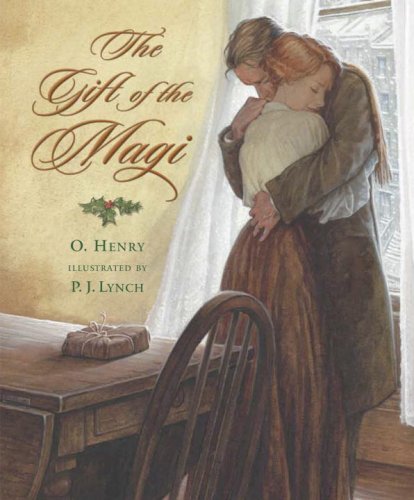
Do you all know P.J. Lynch? He's done illustrations for lots of children's books, such as The Christmas Miracle of Jonathan Toomey, and he's also apparently collaborated on a book of Irish myths and legends, something I could totally go for. I was doing some Christmas shopping at Barnes and Noble a few nights ago (shocker), and I came across O. Henry's story, The Gift of the Magi, done with P.J. Lynch's illustrations. If you're not sure what to get for that niece or nephew, or really anyone (I am a firm believer in giving kids' books to adults), do yourself and them a favor and go get this one. The combination of O. Henry's little side conversations he has with his readers, his excellent word choices and his fondness for his characters, coupled with the warm and gently beautiful illustrations, makes for a delightful read. Some of my favorite bits and pieces (the first one, admittedly, because it thematically ties in so nicely with my previous post):
There was clearly nothing to do but flop down on the shabby little couch and howl. So Della did it. Which instigates the moral reflection that life is made up of sobs, sniffles, and smiles, with sniffles predominating. (That's for you, Mary Powers.)
Now, there were two possessions of the James Dillingham Youngs in which they both took a mighty pride. One was Jim's gold watch that had been his father's and his grandfather's. The other was Della's hair. Had the Queen of Sheba lived in the flat across the airshaft, Della would have let her hair hang out the window some day to dry just to depreciate Her Majesty's jewels and gifts. Had Kind Solomon been the janitor, with all his treasures piled up in the basement, Jim would have pulled out his watch every time he passed, just to see him pluck at his beard from envy.
Oh, and the next two hours tripped by on rosy wings. Forget the hashed metaphor. She was ransacking the stores for Jim's present.
She got out her curling irons and lighted the gas and went to work repairing the ravages made by generosity added to love. Which is always a tremendous task, dear friends -- a mammoth task. 
"Maybe the hairs of my head were numbered, but nobody could ever count my love for you." Out of his trance Jim seemed quickly to wake. He enfolded his Della. For ten seconds let us regard with discreet scrutiny some inconsequential object in the other direction.

So, yes. Go buy the book. Or buy five copies of it. And get The Christmas Miracle of Jonathan Toomey while you're at it. Merry Christmas, friends!


Saturday, December 7, 2013

Why Comedies Make Us Sad

I remember a friend saying once that he never feels happy at Easter or Christmas, and that he gets inappropriately joyful during Lent. And I know what he meant! I realize how petulant this might sound, but I can't remember the last time I didn't feel let down at Christmas. "Is this all? Surely there must be something else." Yes, childish a thought it might well be, but I will venture to protect my dignity by saying I'm actually hitting on something deep in that dissatisfaction. And while I do experience some joy on Easter, and there have occasionally been giddy-happy Easters (really only one comes to mind), I usually feel much more at home on Good Friday and often do get that sense of a big, giant let-down come Easter Sunday.

Gillian Welch is one of my all time favorite musicians. She has a dark sort of heavy low voice and sings a lot of depressing bluegrass songs, which is why people usually turn up their noses when I say, "Oh my gosh! You don't know Gillian Welch? You have to listen to this." They listen to 30 seconds of her with a wrinkled nose and a frown, at which point I stop casting my pearls. One of her songs (not actually one of my favorites, but this one is, if you'd like to try not being a swine) has a verse in it that pretty much sums up my whole attitude about tragedies:

Now there's something good in a worried song
For the trouble in your soul.
For a worried man's been a long time down,
Down in a deep dark hole.

Now even if you don't like her voice, can we at least agree she's dead on here? There is nothing more obnoxious when you're in the pits than cheerful people. If we're feeling sad and out of it, sometimes the appropriate thing to do is wallow. Yes, under certain conditions, I approve of wallowing. And the best way to wallow is to find other wallowers. Go have "a good cry," with a marked emphasis on good.

Migrant Mother, by Dorothea Lange (framed with Gillian Welch in my house; I always think of them together)

I'm going to go a step further, and this is where you all might take issue with my position (as so many of my friends have already in conversation). Even when I'm on top of the moon, I get that little voice niggling in the back of my head saying such helpful things as, "Enjoy it while it lasts, Ellen, cause you know what's just around the corner. Everything will be back to its usual self before long." This, in short, is why comedies never really do it for me. And I'm talking about comedy in that sometimes-forgotten sense that the Greeks and other playwrights meant it; it doesn't have to be something silly -- it just has to end with order instead of chaos. I'm not saying I never cheer when the hero gets his lady-love, or that I sulk in the corner when Maleficent is thwarted and defeated (Sleeping Beauty is superb, by the way; the hero conquers "All the powers of hell" with the "Sword of Truth" allowing that "evil die and good endure.") But there is, nonetheless, that something niggling that also says, "Yes, that's all as it should be, and, you're not there yet." Comedies make us feel lonesome and dissatisfied, somewhere underneath, because they aren't true to the life we know here on earth. They highlight, they emphasize, that sense of isolation and not really belonging and wondering where on earth our place is.

And hey, that's where the problem lies. Our place isn't on earth. Of course we never feel entirely right or comfortable here. Comedies can help us by giving us a paradigm of how we should try to live, and what, in the grand scheme of things, will happen (Jesus won, by the way), but the fact of the matter is we're still in the trenches. While the universe has been claimed for The Good, we, as individuals, haven't reached that end yet. The conclusion of a proper comedy shows an ordered state where we aren't and haven't yet been. But we know in our heart of hearts we belong there. It would be decidedly odd if we could look in through that window and not get some sense of longing or yearning.

And I suppose that this is why liturgically penitential seasons make more sense to our sorry selves than the joyful ones. Perhaps our inability to experience that palpable joy is in direct proportion to our selfishness, as in, we can't bring ourselves to get over ourselves and get happy about the big picture victory. Maybe that's my problem. Because yes, Jesus has fought that fight and conquered Death for all mankind. He did it for me, too. But if my particular share in the battle were already won, I wouldn't have this daily struggle nonsense to deal with. Sometimes, the majority of the time, there's a trouble in my soul, and it's good and helpful and human for me to hear a worried song, sung by someone else who's also been down in a hole. Death shalt die. Thank you, Mr. Donne, for the future tense. We know it will happen, eventually, and we can take certain comfort in that, but we're not there yet.

And with that, here's another Gillian Welch song, quite possibly my very favorite one. The relevant words here are in the chorus (but it's all a good song):

We cannot have all things to please us
No matter how we try
Until we've all gone to Jesus
We can only wonder why.


House-keeping: 
  • I've been redrafting some of the more popular posts from here for my writing duties over at Dappled Things blog (Deep Down Things) on the 3rd and 21st of every month. So, if you want a chance to revisit some old discussions, and see what other people are writing about, amble over.
  • I've got about a week left in the semester. Please say a prayer or two that I finish all my work in time!
  • I'm more sorry than you know that the frequency and sometimes the thoughtfulness of my posts here have declined. Unfortunately, things being what they are, I'm afraid that won't change any time soon. I have many things I would like to write about for you all (I carry a list around with me these days entitled "Blog Ideas to Develop") but I have that whole "Be responsible; do your work" voice niggling along with all the others. Lots of voices in this head . . .

Monday, November 25, 2013

Dappled Things and Other Things

I don't think I've yet mentioned here that I started work as an assistant editor for Dappled Things in early September. Most of you might know that magazine already. If you don't, check out their website. Oh yeah, and their blog, because, you see, I get to help with that, too!

I get to do lots of stuff for them like sorting submissions, recommending which pieces deserve further consideration, discussing and voting on final acceptance, and then editing the work when it's been accepted and getting in touch with authors about making any necessary changes. I've really enjoyed the work, even on top of my regular job and school and choir, because it makes me think seriously about the kind of writing I like to think about, and it gets me in touch with some really fantastic people. Also, it turns out that two of the guys I knew in college, Chris Petter and David Harman, do work for them as well. As a result, I get to feel very smug about my alma mater; who doesn't love that?!


All the behind-the-scenes work for the magazine is done online, which is how it can be staffed with people from all over the place -- and I'm talking from different countries, not just Montana or Virginia. Another awesome thing about it is that it's a hardcore non-profit, meaning we all do the work because we love it and believe in it; no paychecks involved. Don't get me wrong. I would be ever so happy to get an extra paycheck every once in a while. But, it also makes me happy to do this work, paycheck or no.

Our founder, Bernardo Aparicio Garcia, recently sent out a short fundraising video and asked the staff if we could spread it around (printing and distribution costs add up, you know). He talks about the mission of the magazine, the role of beauty in our culture, and what we can do in the world of art to rededicate modernity to its proper end. So give it a look-see, wander over to the fundraising page, and think about what you might do.

I'll leave you today with some words from Gerard Manley Hopkins, as it is his poem, Pied Beauty, that was the inspiration for the name of this magazine. I've been thinking a lot this last month about the relationship between joy and sorrow, and our attraction to sad things, and why we sometimes experience desolation when reason tells us we should be joyful. Hopefully, that will come out as a full-length blog post before too long. In the meantime:

What would the world be, once bereft
Of wet and wildness? Let them be left,
Oh let them be left, wildness and wet;
Long live the weeds and the wilderness yet.
-Inversnaid

Yours truly hiking near Inversnaid, June 2011

Saturday, November 16, 2013

Reflections on Reflections

(Shocking disclosure, in case you hadn't picked up on this already: I'm a Catholic.)

I was saying the rosary a couple of weeks ago, and I noticed the shadow of some of the beads on the pew. In a generous estimation, I think I'm maybe at a 2% successful meditation status for the rosary; this day was no different. I started looking at the shadow because it was so pretty. I was really good at focusing on that shadow. There was something attractive, or, shall we say, entrammeling about it. I spent the next little while going over it in my mind, and trying to figure out why I liked the shadow so much more than the rosary in my hand. Because really, though I say it myself, I do have a be-yoo-ti-ful rosary.


This question prompted other questions.
  1. What's the deal with shadow puppets? and other shadow games?
  2. Why are we obsessed with taking pictures?
  3. Why do babies like mirrors?
  4. Why do children play make-believe?
  5. Why do we like books, movies, or other forms of art?
  6. What are the troglodytes focusing on inside Plato's cave?
 (Maybe one of these days I'll start thinking about, you know, Mary and Jesus when I say the rosary. Here's hopin'. . .)

People are all about imitation. That's certainly part of it. There's a fruitfulness, a richness, and a reminder of the power of creation (which is, mind-blowingly, a partly human power) in every copy of something real. As for kids playing make-believe:
Notes on Imagination

There must be a reason to children's building
castles out of blankets,
a reason they're the masters of all
they see, without self-conscious
inhibitions.

Are they bridging a vast native gap
as they scale imaginary forts, or is it
merely a blanket, held
down on a rocking horse with a heavy book
they can't read?
I have a special place in my heart for that poem; it was the first thing of mine I ever saw in print for distribution, and it has a great back story (thank you, Joshua Neu). I bring it up now, though, because I think it gets right to the heart of all these questions.

We are powerful. We are the privileged of all God's creations. And men and women are beautiful creatures, physically and spiritually. And that spiritual part, that part we can't disect and touch and put band-aids on, that part we can't fully understand and that sometimes scares the you-know-what out of us, is a good enough excuse for us to try to hide from reality. Shadows, excessive pictures, escapist novels and grown-up make-believe can all become and often are a way of hiding from real life. Some plausible answers to that list of questions:

1. What's the deal with shadows?
I should have been dwelling on the mysteries of the Incarnation and the Redemption of the world. But instead, I was looking at the poor copy of beads that help me count to ten, because I can't even stay focused long enough to do that five times on my own. Way to go, Ellen. Now, more seriously, we're fascinated with them because they are a reminder of our creative power; our shadows can't exist without us, and they'll copy every single thing that we do. And they keep us company all the time. They must really love us, right? So we love them. Just ask Peter Pan.

2. And pictures?
How many times have you heard: can you please just put the camera down? Or have you been to a wedding where you were asked not to take pictures during the ceremony? Too much of the time, our efforts to record reality end up distracting us from reality. We see through a glass dimly.

3. And mirrors?
 Usually I take a baby to a mirror when he's crying. I show him my hand in front of the mirror, and then hold up his hand, and let him see how his mirror-hand and my mirror-hand mimic our real hands. Almost without fail, this stops him from crying, makes him forget about whatever made him upset, at least for a little while. But fascination with mirrors is a dangerous thing, isn't it? Don't forget Narcissus, or the mirror in the Harry Potter books that destroys men with longing and divorces them from reality, or, for that matter, the mirror of Snow White's wicked stepmother.

4. And children's games . . .
Children playing make-believe is a good thing. Stretching their imaginations, learning to think of ways and possibilities outside of their immediate reality, and sometimes connecting their own selves to great archetypes that they'll learn to follow and live up to, all help them to be better people. But even children can use their imaginations to escape from reality in less than innocent ways (yes, I'm talking about lying little mischief-makers). Eventually, though, children grow up, and they'll have to stop living in a world of make-believe, steady the rocking horse, and find out what the heavy book says.

5. Books and movies.
Grown-ups (?) who live in novels and movies, even if they're good ones, are living in a fabricated world. They are the children who never figured out what the imagination is actually for. Imitation of something real is good, but only if it makes you think about the real thing in a new light, not if it's such a paltry or misused imitation that it makes you forget, or wish you could forget, what is actually real.

6. The Troglodytes.
So, Plato's cave-dwellers, chained and watching those images, divorced from reality, thinking they know what is real, unwilling to hear that what they see is a shadowy imitation and not the real article at all, well, that's us, isn't it. They're focusing on what they wish were real, on what they have convinced themselves is real. But if they want to be grown-ups, one day they're going to have to break the chains, stop fooling themselves, and actually come face to face with real truth. A lot of things look real enough, are vague enough and ill-defined enough that we can make of them whatever we need to be comfortable with them. But they're only weak, insubstantial and paltry imitations of what we're really made for.

Reflections, games, books, stories, pictures and art are all good things, oftentimes beautiful things, which is why we like them. But they're not it. They're copies. So don't stop there. Stop when you find out what they're copying, and, more importantly, why it's worth being copied.
Thursday, October 31, 2013

The Keats Quiz

How well do you know him? In honor of his birthday, I've made up a quiz for you all. (Yes, this is what I was thinking about lying awake at midnight last night when I should have been asleep; I hope you're grateful.) I don't know how to do the fancy actual multiple choice thing where you skip ahead to a new page for each question, so please do bear with my stone-age tactics. No looking up answers, all you cheaters out there! Honor system, please. And then, find out where you rank and what your score indicates about you.

1. Keats was:
A. Irish
B. Scottish
C. English
D. Welsh

2. The lady with whom he was in love when he wrote Bright Star was:
A. Fanny Brawne
B. Fanny Price
C. Fanny Dashwood
D. His mom

3. The disease which claimed him (and several of his family members) was:
A. Typhoid
B. Tuberculosis
C. Tendinitis
D. Love

4. Before he gave himself over to the muse of poesy, Keats studied to be a(n):
A. Apothecary
B. Barrister
C. Librarian
D. Farrier

5. At the age of 25, Keats died in a small apartment in Rome overlooking the:
A. Roman Forum
B. Tiber River
C. Vatican Gardens
D. Spanish Steps

Name that poem!
6. "Silent, upon a peak in Darien."
A. Ode to a Nightingale
B. Ode on a Grecian Urn
C. On first looking into Chapman's Homer
D. Endymion
E. Bright Star
F. When I have fears that I may cease to be

7. "Forever wilt thou love, and she be fair."
A. Ode to a Nightingale
B. Ode on a Grecian Urn
C. On First Looking into Chapman's Homer
D. Endymion
E. Bright Star
F. When I have fears that I may cease to be

8. "A thing of beauty is a joy forever. . . it will never pass into nothingness."
A. Ode to a Nightingale
B. Ode on a Grecian Urn
C. On First Looking into Chapman's Homer
D. Endymion
E. Bright Star
F. When I have fears that I may cease to be

9. "Darkling I listen, and for many a time I have been half in love with easeful death. . ."
A. Ode to a Nightingale
B. Ode on a Grecian Urn
C. On First Looking into Chapman's Homer
D. Endymion
E. Bright Star
F. When I have fears that I may cease to be

10. ". . . before my pen has glean'd my teeming brain. . ."
A. Ode to a Nightingale
B. Ode on a Grecian Urn
C. On First Looking into Chapman's Homer
D. Endymion
E. Bright Star
F. When I have fears that I may cease to be

Extra Credit: Arguably what he is most remembered for, he developed the poetic technique of (fill in the two blanks), something he discussed in detail in one of his letters to his brothers George and Tom: "... that is, when man is capable of being in uncertainties, mysteries, doubts, without any irritable reaching after fact and reason" (21 Dec 1817).

So, how did you do?

Answer key:
1-C; 2-A; 3-B; 4-A; 5-D; 6-C; 7-B; 8-D; 9-A; 10-F

Extra Credit: Negative Capability

And what does your score mean?

0-1: Go back to kindergarten!
2-3: You're lazy, but passably intelligent.
4-6: You passed high school English
7-10: You either were an English major or should have been one.
11: Grad school isn't good enough for you.

Fanny Brawne and the man himself.

Happy Birthday, Mr. Keats.


Monday, October 21, 2013

Shakespeare's English and Various Notes

Have you all seen this video yet?


Believe it or not, I'd be happy to marry into this family. Man, what a life.

Other exciting things:
  • I'm relatively certain I passed my bio midterm. Also, a midterm with no essays? What world is this?
  • I've been working on the staff of Dappled Things Literary Magazine for almost two months now. I get to blog for them! And edit for them! And sort submissions! It's lots of fun. Two of my fellow UD graduates are also on the staff, which makes me all kinds of proud of my alma mater. 
  • I joined a writing group. Tomorrow they're critiquing something I wrote. Am I nervous? What do you think?
  • An interesting reflection on language barriers from one of my little brothers: He's at a French seminary in Florence. Although many of the seminarians do speak English, it is preferred that everyone speak French. He's gotten to the point where he can understand it, and he can speak it well enough most of the time. But he said that when he hears people speaking French, he doesn't hear distinctions of voices; he just hears French. In English, he can hear variations and inflections and tones of voice that open up someone's character in a way that can't be done when he's listening to a foreign language. He didn't realize this was happening until one of the French seminarians started speaking English to a visitor. Not only was this the first time that he'd heard him speak English, but he said it was also the first time he heard his voice. Quite suddenly he had a much fuller, richer understanding of who his fellow student is. And this is another reason I love language. 
All right, then, friends. Back to work.

Monday, October 7, 2013

Your Festering Prayer Life

I picked up The Screwtape Letters again over the weekend. If you're not familiar with them, they are what I think to be one of CS Lewis' more ingenious scenarios: an uncle demon who is well-practiced in his trade giving advice to his nephew, a junior tempter. I mean, really, what a marvelous idea.

My roommate and I were discussing the third letter. In addition to what you might glean from the following excerpts, remember her words of wisdom on the subject; those "daily pinpricks" and "unendurable irritations" are cemented as such when the two people don't talk to each other about them, either out of fear of confrontation, or from some misguided attempt to "be noble" and "offer it up" and view the other person as "a source of constant mortification." Correct me if I'm wrong, but it seems that holding your spouse/sibling/roommate/parent in the same category that you do a medieval flagellum is not the way to love and respect them. A personality can be a mortification; we all have those individuals in our lives who "rub us the wrong way" with whom we just don't "mesh" (I'm using a lot of quotation marks -- sorry). But somebody you live with, rather than that person who runs in the same social circles and whom you should maybe just try to avoid, cannot remain in that box of "the person who exists to get me to heaven faster because they're so annoying." (And yes, I do realize that no one should be in that box. But if you're going to start getting people out of it, start with the people you live with.)


Confront them. Talk to them. Work it out. Realize that you're annoying, too. Don't let hatred fester in your "prayers." (I don't have it all figured out, either, just so we're clear. A note on my list of classes for this year: "COMM 114: Communication Skills - still required." Ouch.)
My dear Wormwood,
I am very pleased by what you tell me about this man's relations with his mother. Keep in close touch with our colleague Glubose who is in charge of [her], and build up between you in that house a good settled habit of mutual annoyance; daily pinpricks. The following methods are useful:
1. Keep his mind off the most elementary duties by directing it to the most advanced and spiritual ones. Aggravate that most useful human characteristic, the horror and neglect of the obvious. You must bring him to a condition in which he can practise self-examination for an hour without discovering any of those facts about himself which are perfectly clear to anyone who has ever lived in the same house with him or worked in the same office.
2. It is, no doubt, impossible to prevent his prayer for his mother, but we have means of rendering the prayers innocuous. Make sure that they are always very 'spiritual', that he is always concerned with the state of her soul and never with her rheumatism. His attention will be kept on what he regards as her sins, by which, with a little guidance from you, he can be induced to mean any of her actions which are inconvenient or irritating to himself. Thus you can keep rubbing the wounds of the day a little sorer even while he is on his knees; the operation is not at all difficult and you will find it very entertaining.
3. When two humans have lived together for many years it usually happens that each has tones of voice and expressions of face which are almost unendurably irritating to the other. Work on that. Bring fully into the consciousness of your patient that particular lift of his mother's eyebrows which he learned to dislike in the nursery, and let him think how much he dislikes it. Let him assume that she knows how annoying it is and does it to annoy -- if you know your job he will not notice the immense improbability of the assumption. And, of course, never let him suspect that he has tones and looks which similarly annoy her. As he cannot see or hear himself, this is easily managed.
                                                                                                Your affectionate uncle
                                                                                                 SCREWTAPE
Bear in mind, if you find yourself prompted to return to this "collection of letters" or to pick it up for the first time, what Lewis warns in his preface:
There are two equal and opposite errors into which our race can fall about the devils. One is to disbelieve in their existence. The other is to believe, and to feel an excessive and unhealthy interest in them. They themselves are equally pleased by both errors and hail a materialist or a magician with the same delight.
Evil is real and actively working to capture you. Be careful how and why you choose to grow in your understanding of it.